
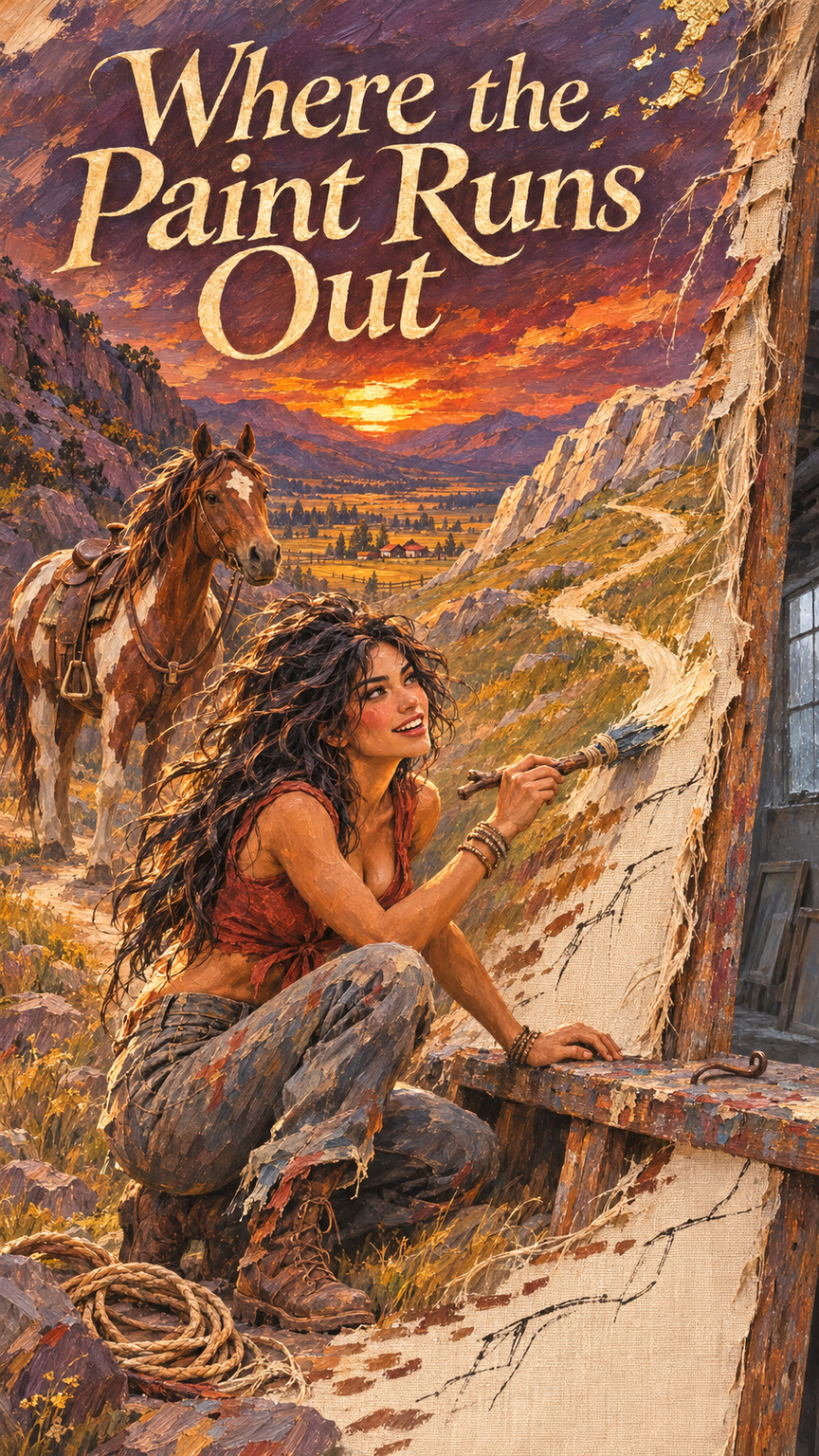
Dessa beat her father to the far gate by half a horse and a disputed corner.
“There was a fence in your way,” he said.
“Not for long.”
Calico danced beneath her, pleased with the jump. Dessa leaned forward to rub the mare's warm neck. She had lost the scrap of leather holding back her hair, and it flew about her face in black ropes. Her father arrived at a walk, pretending that had been his intention all along.
Beyond the gate, the western mountains stood purple against a gold sky. Somewhere behind them there must be another country. Dessa had been arguing for its existence since she was small enough to ride in front of her father's saddle. At twenty-three, she was still being told that the mountains were the end of the country, as if this settled anything.
Her father leaned from his saddle to catch the gate rope.
Something bright landed on his sleeve.
“You've caught fire,” Dessa said.
He brushed at it. The bright thing rose between them, turned once, and settled on Calico's mane. It was thin as the skin inside an eggshell, gold on both sides.
Dessa caught it on a fingertip. Through it she could see the blue veins of her hand.
Above the mountains, a little square of the sky had gone white.
Her father followed her gaze. They sat quietly while a second flake came down, then a third. One caught on the gatepost, making the weathered wood briefly magnificent.
“There's a break in East Tooth,” he said.
The narrow mountain had split from summit to foot. White showed through the break, straight and clean, though there was no snow anywhere else on the range.
Dessa put the flake in her jeans pocket.
“Don't go up there alone.”
“You could come.”
He looked back at the horses scattered across the pasture. They had left the young ones in the far paddock for gentling.
“Tomorrow,” he said. “We'll take a look tomorrow.”
She slid from the saddle to open the gate. A tie of her red shirt caught on the post. She turned, expecting a tear.
Five red strokes hung in the air between cloth and wood.
They had the shape of threads until she looked closely. Then she could see the little ridges along them, as though something soft had been dragged by bristles. She touched one. Red came away on her finger. The stroke shortened.
She knotted the remaining tie, pulled herself into the saddle, and looked toward East Tooth.
Her father had seen it too.
“Dessa.”
“I'll keep to solid ground.”
“That's not what I asked.”
She knew. It was why she had answered so quickly.
Calico turned under a touch of her knee.
“You owe me another race,” he called after her.
“You'll have to practice.”
She looked back once. He was still at the gate, watching her ride.
The crack was wider when she reached it.
At its foot lay no fallen stone. Instead, little curls of purple and brown had collected among the scrub. The wind lifted them like dry leaves. On the mountain face, a long strip of rock stirred.
Dessa dismounted. Calico would go no closer, and Dessa had learned to take a horse's refusals seriously, even when she intended to disregard them.
She looped the reins over a low branch and approached on foot.
Inside the crack, the mountain was made of threads.
They crossed at right angles, thick pale cords with brown lodged in their hollows. Higher up, where the purple rock peeled back, more of the weave showed. Dessa pressed a palm to it. It felt coarse and dry. No grain of stone came away.
She pulled her hand back and tried again.
The threads were still there.
A narrow shelf led into the split. Dessa followed it sideways, one hand against the mountain. The shelf grew paler under her boots. Its pebbles became brown dashes; its shadows broke into separate lines. At the end, a black outline continued across white ground, describing a ledge that did not exist.
Beyond that outline was a room.
For a moment she thought it was a room built for giants. Then she blinked, and a bent nail on a wooden shelf looked no larger than her thumb. Looking back toward Calico made it huge again.
She closed her eyes until the dizziness passed.
Cold air touched her face. It smelled of wet wood and something sharp she could not name. Rain fell through a missing piece of roof. There were no hoofprints, no footsteps, only bird tracks in the dust and a fallen nest among hardened brushes.
Across the room stood a tarnished mirror.
In it she saw an easel, a broad frame, and all the country she had ever known.
The ranch was a cluster of red roofs. Horses moved through the gold grass. The western mountains curved around the valley; East Tooth had an ugly white split near the right-hand edge. At that split stood a girl in a red shirt, holding her hair out of her eyes.
Dessa lowered her hand.
The girl lowered hers.
She went back three steps. The country spread around her again, miles of it, with Calico waiting on the trail. She smelled warm sage and horse sweat. A fly worried the mare's ear.
Then she went forward, and it was a picture in a wooden frame.
“Oh,” she said.
Nothing else came.
Other pictures leaned against the room's walls. In one, a woman shook a blanket from an upstairs window above a blue harbor. In another, people were crossing a white lake, carrying their skates. One man sat down to put his on. He had no reason to look up at the dusty room beyond his weather.
A paper label was nailed to the shelf beneath Dessa's country.
Western pasture. Work begun 204. Abandoned 209.
Beneath it, in another hand:
Inventory of uncompleted worlds, 547. No subsequent work recorded.
She subtracted the dates, lost her place, and did it again. Three hundred and thirty-eight years between the laying down of a brush and the writing of that second note. The note itself was brown with age.
Someone had left them here before her father's grandfather was born. Before his grandfather's grandfather. The mountain stopped at a line because the person making it had stopped there.
She looked for a name, but the corner of the label had rotted away.
On the shelf lay a palette with shallow cakes of color. A brush had dried into its blue. Under the easel, weeds grew from a fallen roof tile.
Dessa called into the room.
Her voice came back thinly. A bird startled out through the roof.
Nobody answered.
She stood for a long time with one boot on the last brown dash of her country. Then she reached through the split.
Her fingers closed around the shelf.
The wood had a splinter under its edge. She felt it distinctly, pressing the ball of her thumb. Her hand grew heavy. Rain struck her wrist, so cold that she gasped.
She pulled.
Something tightened far below her elbow. Across the valley, a red mesa began to unroll in a narrow ribbon.
Dessa stopped moving.
The ribbon hung between mesa and arm. Under its loose end was white.
She eased her weight back. The red settled into place.
Her heart was beating hard. With her hand on the shelf she could hear a second, louder thump in her wrist, feel the dense weight of those fingers. It was still her hand. She could make it curl. She could spread it flat against wood that had never been part of her sky.
The room opened into another room, and beyond that was a doorway full of gray daylight.
She wanted to stand in it.
Dessa hooked her other hand over the shelf and lifted a little farther.
Gold ran over her shoulder. The ranch sky peeled up from the horizon in a great shining sheet.
Under it, the horses broke into a run.
Calico tore free of her branch. Dessa saw the mare's small brown-and-white shape turn toward the trail, then swerve as the lifted sky curled over her. A strip of pasture rose with it. The far fence came away post by post.
Dessa let go.
She fell backward onto the unfinished shelf. Her elbow struck a ridge of brown, and she scrambled farther in, dragging both hands after her.
The sky came down in a long, slow fold. Gold rushed off her shirt. Red left her arm and rolled back into the mesa. The fence posts struck earth.
Calico stood trembling below the split.
Dessa crawled to her, caught the trailing reins, and pressed her face against the mare's neck. The familiar smell nearly undid her.
“I know,” she whispered. “I know. I won't.”
Above them, a narrow piece of purple lifted away from East Tooth.
The color she had borrowed was back. But the split was longer. A fine popping sound traveled along it, thread by thread.
She had put everything down and it was still coming apart.
Dessa led Calico onto the broadest stretch of solid trail and went back to the edge.
She tried pressing the lifted rock into place. It lay flat under her palm, then rose behind her when she moved. She took the gold flake from her pocket and worked it into the exposed threads. It covered a thumbprint of white. There was still a white spot in the sky.
She dragged a soft brown stroke across a bare patch and made a foothold. For an instant she was delighted. Then she saw the hollow left where the stroke had been.
Whatever she took had to come from somewhere.
Rain pattered on the shelf outside. A runnel crossed the rusted head of a nail in the frame and dripped onto the exposed weave. A red stain spread.
Dessa watched the distant mesas.
Nothing faded.
Another drop fell. The stain darkened.
She bent close. That red had come from the room.
Her lasso hung from the saddle. She brought it back, made a loop, and cast it through the split around the bent nail on the shelf. When she lifted, a thin line of color rose off the far rock.
She lowered the nail at once.
Then she rubbed the wet rust along the loop, following the same twisted fibers with her fingertip. She worked it into the knot. She had tied that knot a thousand times; she knew how it tightened, how the rope lay against itself.
She lifted again.
The nail came up. Its weight drew the loop taut.
The mesas stayed red.
She held it longer, her shoulders aching, staring from the knot to the country. Then she lowered it, untied the knot, and tied it again. The rust-colored end of her rope was still her rope. Beyond the split, it could hold something without hauling a mountain after it.
Dessa put a little rust on her forefinger.
She kept it moving as she worked, curling and straightening it, watching the crease over the knuckle. Then she pushed it into the room and touched the nail.
Cold. A rough place under its head. The same crescent-shaped scar beside her fingernail.
She bent the finger. The cold place moved against her skin.
No ribbon rose from the valley.
She drew her hand back. Her finger was attached, alive, answering her. She pressed it against Calico's nose. The mare snorted warm breath over it.
Dessa laughed so loudly that Calico took a step away.
“Sorry,” she said, laughing again.
The popping in the mountain brought her head up.
She ran for her saddlebag.
The old brushes were hard as sticks. Dessa cut a strip from the loose cuff of her jeans, unpicked its end, and bound it around a twig. She ground rust and fallen plaster on a flat stone. With her treated rope she hauled the palette close enough to scrape its unused cakes into the rainwater on the shelf.
There were colors here that had never been mountains or horses or anyone's skin.
She worked them into her right hand, slowly at first, turning it to follow the lines she already knew. Beyond the split, her fingers grew firm around the brush. She braced that hand on the shelf. Nothing moved in the valley.
Her left hand followed, then her arms.
She could have kept going.
Instead she reached beneath the shelf for a fallen length of frayed cord.
The split had passed the top of East Tooth. Below it, a strip of the sunset was lifting. Dessa drew the cord into the raw weave, catching its loose fibers through those of the canvas. She pulled the sides together as she would the edges of a torn saddle blanket, and worked fresh color over them.
Inside the country, a pale ridge rose from the mountain's broken flank.
It came up fast. Calico shied as limestone shouldered through the bare ground, carrying grass on its back. Dessa flattened her brush. The ridge broadened. She bent its steep side into a slope, put a curve where a horse could turn, and watched a little shower of new stones settle along the trail.
Her hands were shaking. She had never made a place before.
The lifted sky sank onto it. Across the valley, the ranch roofs stopped trembling.
She drew another length of cord through the split and covered it with a broad white stroke. The popping ceased above her head.
Calico approached the new ridge. She put one hoof on it, withdrew it, and tried again. Then she stood there, solidly, ears forward.
Dessa touched the warm rock with the toe of her boot.
Only a small opening remained around her, where she knelt half in the country and half against the shelf. When she took her hands from its edges, the new ridge began to lift at its near end.
She pressed the edges together until the rock settled, then threaded the treated end of her lasso through the loose fibers. A pull on the running end kept the edges snug against her waist. She eased one knee away from the lower edge. A slit opened between her leg and a loop of rope, and the ridge's pale lip began to lift again.
She pushed her knee back. The slit filled; the rock settled.
She tied the running end against the frame, keeping the edges pressed to her clothes. Her body was part of the patch. When she left, she would have to draw the sides together behind her and cover the join with fresh color.
The raw ground was the only way through she had found.
She looked out into the room, then back toward Calico.
Her father was coming up the trail on foot.
He had left his horse below the break. His shirt was gray with dust, and he was breathing hard. At the sight of her he stopped so abruptly that Calico turned to look at him.
“Are you hurt?”
“No. Don't step past the white rock.”
He looked down at it, then at her hands on the shelf, then into the room. His mouth opened. He shut it again.
“The sky came loose,” he said.
“I did that.”
He came closer, keeping to the stone.
Dessa pointed to the running end of the lasso.
“Will you hold this? Keep it just tight enough that the edge doesn't lift.”
He took it. She eased her knot loose and watched him take the strain. The ridge stayed still.
“Good,” she said.
Her father looked through the gap for a long time.
“That's a floor.”
“Yes.”
“And we're—”
She nodded toward the mirror.
He leaned until he could see it. On his small painted face, reflected across the room, she watched the discovery arrive.
He sat down on the ridge.
Dessa waited. The rope lay steady in his hands.
At last he touched the rock beside his knee.
“I thought these were mountains.”
“They are.”
He dug his fingers into the warm grit. Then he looked at her new hands.
“What happened to you?”
She told him about the red mesa, the sky coming up, the stain from the frame. She showed him the wet color in the stone, the lacing, the brush with its denim bristles. He listened without looking away from her face.
“You can come back on this side?” he asked.
“I can still come back.”
“Then come home.”
Calico nosed at his shoulder. He reached up and caught her bridle, an ordinary movement Dessa knew as well as the shape of his hands.
She could slide down from the shelf. They could close the gap, and there would be a new ridge to race along. She would have to tell everyone what she had seen. Tomorrow she could wake in her own bed and go outside to a whole, impossible country.
Through the gap, rain struck the floor. Each drop broke into smaller drops. Beyond the distant doorway, a branch moved in wind she had never felt against her whole body.
“I want to go,” she said.
Her father looked down at the rope.
“I don't know how to get back after we close it,” she said. “I might find a way. I don't know.”
He pulled a little slack through his hand, then took it up again.
“I came to fetch you.”
“I know.”
For a while there was only the rain, and Calico breathing between them.
“You could come too,” Dessa said.
He looked back along the new trail toward the pasture. His horse was waiting below, cropping the scrub. Farther off, the young ones had gathered along the fence.
“No,” he said quietly.
She nodded. It hurt, although she had known his answer.
Her father passed her Calico's reins.
“You'll have to tell her.”
Dessa drew the mare close. Calico planted her feet at the very edge of the white rock, stretched her neck, and breathed into Dessa's hair. Dessa put her arms around it. She knew the exact weight of that long head against her shoulder, the soft place under the jaw, the little impatient jerk that meant she was holding on too tightly.
She loosened her arms.
“No more jumping the south fence,” she told the mare.
Her father made a small sound.
“She won't believe you.”
“I don't believe me.”
She kissed the white patch between Calico's eyes and passed back the reins.
Dessa worked quickly now.
Her father kept the lacing close while the new color followed the shape of her shoulders. It became warmth under her shirt, a new weight in her chest. The same breath went in; she felt it open her ribs in the cold room.
She used the mirror for the places she could not see: the black tangle of her hair, the back of her neck. Where she missed a patch, her reflection trailed into loose lines. She turned the brush and followed them, worked along her cheek and under her jaw. She was giving substance to a shape she had been moving all her life.
She painted her red shirt and its shortened tie, the worn denim, her knees and boots. Once she had an exterior foot, she lowered it from the shelf and found the floor. Her leg took her weight. The stone was colder than the mountain had been.
No gold came out of the sky.
Her father watched the valley while she finished. When she asked, he told her that the roofs were still, the far fence was straight, the mesa had all its red.
Finally she stood beside the easel. Only her left hand remained through the opening, resting in her father's.
She could see him both ways: a man close enough to touch, and a small figure inside a frame. She kept her eyes on the first.
“One last pull on the rope when I take my hand out,” she said. “Then tie it. I'll cover the join.”
He nodded.
His thumb moved over her knuckles. It had always been rough in the same place.
“I would have won tomorrow,” he said.
“You'd have cut the corner.”
“Learned it from you.”
She laughed, and could not manage anything after it.
He let her fingers go one at a time.
Dessa withdrew her hand. The lacing drew tight behind it, leaving a hairline of white between two turns. The ridge's edge shivered. Her father tied off the rope, and she swept fresh color across the join, a long pale stroke from the mountain's foot to its summit.
The rock settled into its new shape.
Her father put his palm against the place where hers rested.
She felt woven fabric, the slight raised edge of her own brushstroke. On the other side he was saying something. She could see his mouth move, but the room held only the sound of rain.
He stepped back. Calico shook out her mane, and no hair brushed Dessa's wrist.
Her father lifted a hand. She lifted hers.
Then he led the mare down the new slope. At the bend he stopped to examine the limestone, bent, and picked something up. He showed it to Calico, who declined to eat it. Dessa laughed through her tears.
They went on. Far below, his other horse raised its head.
Dessa kept watching until all three were safely on the old trail.
When she looked down, her boots were standing in a little spill of blue powder. She lifted one. A clear print remained on the stone floor.
The canvas was no taller than she was. She took its weight carefully, keeping it upright. It weighed less than a saddle. Within it the horses walked on, untroubled, while she carried their whole evening away from the leak and set it against a sound inner wall.
For a little while she stood beside it.
Then wind came through the doorway and lifted the loose tie of her shirt. It held together. Dessa went to see where the wind had come from.