
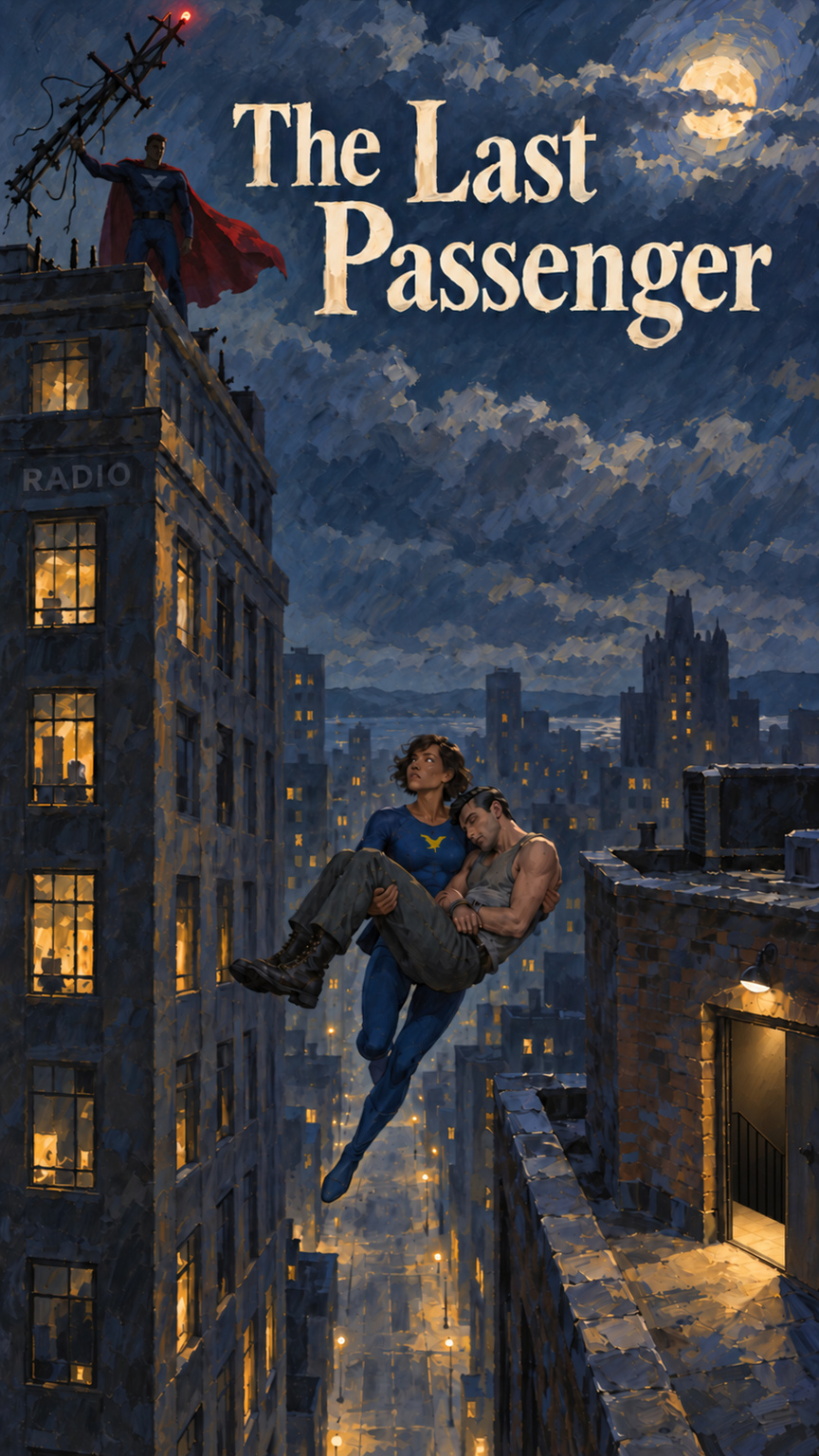
“Attention all heroes, attention all heroes: Switch from subject containment to evacuation. I repeat, evacuate all civilians immediately. Captain Incredible is en route and he is extremely pissed off.”
Copperjack took his hands off Vane's armoured shoulders.
He had spent twelve minutes getting them there. The studio floor was littered with copper scales, broken clasps, one whole sleeve of Copperjack's suit. Now he backed out through the hole where the control-room window had been and pressed his earpiece.
“How long?”
I couldn't hear the answer. Whatever it was made him look up.
“Skylark. Who's left?”
“Two staff. The man in the kitchen, and her.”
I stood in the control room with a woman who had taken off her shoes. One foot was swelling so quickly you could watch it happen. She held both shoes by their straps and stared through the broken window into the studio.
“Mal's in there,” she said.
Copperjack looked at me.
I shook my head.
The armoured man sat against the far wall with his legs straight out. Copperjack had folded the suit's knee joints backwards. Its helmet was on the floor, and without it the man looked almost bored, except that he couldn't stop wetting his lips.
Behind him, beneath the broadcasting desk, Mr Davitt lay dead. Mal to the woman with the shoes. Captain Incredible's father to everyone who would be talking about this tomorrow.
“The living first,” Copperjack said. His voice had gone thin. “I'll get the kitchen man. How's the route?”
“Clear.”
“Finish up. Don't come back.”
He left us. I heard him force the kitchen door, heard someone cry out, and then the glass doors onto the roof flew open. Copperjack ran for the parapet with a man over his shoulder. He jumped, and a moment later his remaining plates clattered on the roof across the avenue.
“Arm round my shoulder,” I told the woman.
She kept looking into the studio.
“You can take your shoes.”
That reached her. She put the arm with the shoes round my shoulder and let me pick her up.
My costume was blue, with a yellow bird sewn over the breast. It hadn't come with pockets. Halfway across the roof she asked if she could put her shoes down somewhere and I said yes, any minute, hang on.
The jump always looked worse than it was. Seven storeys to the street. Across the avenue, the furniture shop had a broad third-floor roof and a door down to the loading yard. I could take one person there. The shop staff and two ambulance people would get them downstairs and into the vehicles. We'd been doing it since Vane's first shot brought down the station's main stairwell. The passenger lift had stopped between floors with nobody in it, thank God. The woman was my ninth passenger.
I could fly about as fast as a person rode a bicycle. On my own, I could go for hours. Carrying someone, I got a little distance, a little height, and then a feeling like holding a sneeze which became steadily harder to bear.
The woman buried her face in my neck when we went over the edge.
Captain Incredible had taught me to carry people. One arm behind the shoulders, one under the knees. Don't hang them by the armpits. Don't let them look down if they don't want to. And if they were heavier than I'd thought, come straight back. No shame in putting someone down safely.
During my first drill I had tried to lift a sack of sand before they let me near a volunteer. I'd got six feet up, lost it, and dropped myself with the sack still hugged to my chest. He'd caught me.
The examiner had said, “You mustn't rely on that.”
The Captain had given me a little shake, still in his arms. “Next time, let go of the sand.”
For months afterward, I had wanted him to laugh at something I'd said.
I set the woman down on the furniture-shop roof. A medic with a shaved head took her elbow, and she swung away from me into the doorway, shoes still dangling. From below came the scrape of a stretcher being loaded.
“That's the last,” I said.
“You too,” the medic said.
I reached up to tell dispatch the station was clear of survivors. My right hand was shaking so much I missed the earpiece.
Across the avenue, someone banged on the roof doors.
The first blow made them jump. The second pushed one open.
Vane came out bent at the waist, staggering, without his armour.
For a moment I watched without understanding. His suit was a room somebody could climb out of. Of course it was. I'd just spent twelve minutes wanting Copperjack to break the room open.
Under it, Vane wore a grey vest and trousers tucked into heavy boots. A pair of restraints joined his wrists in front of him. Copperjack's field case had been open beside the studio door. Vane raised his hands above his head so that I could see.
“I've surrendered!”
I pressed my earpiece properly this time.
“Vane's on the station roof. Out of the suit. Hands restrained.”
Copperjack answered from somewhere with an engine running. “Keep coming. We can't wait for him.”
Vane reached the parapet. His hair was slicked flat by the helmet. He looked along the street, up at the sky, and then at me.
“Don't leave me here!”
The medic had one foot inside the doorway. She looked over my shoulder.
“Is that him?”
I nodded.
She let the door fall against her heel.
I had heard Mr Davitt die. When the microphone had stopped working, he'd leaned out from under the desk to tell Vane that he could use the spare one. Vane had asked him his name. Then he'd made him repeat it. Then he'd said, very clearly, “Tell your son I came looking for him.”
There'd been no time for Mr Davitt to tell anybody anything.
The shot had come through the station speakers. We were in the next room.
I knew Mr Davitt a little. He'd recorded my first safety announcement, because dispatch needed something clear to play when my radio wasn't working. We'd done it nine times. I kept laughing at the part where I said my own name.
He'd shown me a picture of the Captain at ten, skinny knees and a ribbon for coming third in something.
Vane was still shouting.
“I'm going back,” I said.
“You can barely stand,” the medic said.
“It's downhill on the way home.”
She didn't smile. Neither did I.
“Leave him,” Copperjack said in my ear. “There's no time.”
“I'm taking him.”
“Skylark.”
Someone called up the stairs for help with the stretcher. The medic looked at me. “We'll be in the yard,” she said, and went downstairs.
I stepped off the roof before Copperjack could say anything else.
The crossing back took too long. Empty arms didn't help much now. My right shoulder ached deep in the joint, and I had to think about flying instead of just doing it.
Vane met me halfway to the doors.
“What were you waiting for?”
“Sit down.”
“He's coming.”
“I know. Sit down so I can pick you up.”
He sat, badly, with his boots skidding on the roof gravel. I knelt beside him and checked the restraints. Both were locked. I felt round his waist and under his arms; the gun had stayed with the suit.
“Put your hands on your stomach. Keep them there.”
“Can you actually carry me?”
I got an arm behind his back and the other under his knees. He was heavier than the woman. There was a buckle or a fastener in the back of his vest which pressed into my wrist.
“Don't move around,” I said.
He brought his joined hands up towards my neck.
“On your stomach.”
“I need to hold on.”
“Then hold your trousers.”
He gripped a fold of fabric between his cuffs.
I stood. Everything in me asked to put him down.
The station's aerial had a red light on top. All evening it had blinked on and off above the roof, keeping its own time through the shooting and the calls for help. I glanced up at it as I took my first step.
The whole aerial bent sideways.
It didn't fall. Something beyond the light caught it, held it against the sky, and twisted it free of its mountings. The sound arrived after the movement, a long metallic tearing followed by a crack that I felt in my teeth.
Window glass burst out along the upper floors. The roof doors blew shut. For a second the gravel lifted around our feet.
Then Captain Incredible was standing where the aerial had been.
There was a strip of cloud across the moon. I could see the front of him by the light from the studio's broken windows: navy suit, red cape, the white insignia that had been printed on my schoolbag. One of his hands was wrapped round the aerial's broken stem. He let it drop off the edge.
It struck the empty avenue below.
Vane tried to climb over my shoulder.
“Stay still.”
“Go! Go!”
I jumped.
For a few yards we flew. The pressure inside me wavered and caught again. The furniture-shop doorway was open; a yellow light showed the top of the stairs. I aimed for it.
The Captain came in front of us.
I stopped so suddenly Vane knocked his forehead against mine.
The Captain hung in the air without appearing to do anything. I had never been that close to him in flight. We weren't permitted to share his airspace during exercises.
He was looking at Vane.
“Put him down.”
“I can't. We're over the street.”
He glanced at the roof behind me.
“Back there.”
We were below the station roof now. I couldn't get us up there. I could barely go forward. For one stupid moment I thought of how annoyed the examiner would be with me for having to explain that.
“I'm taking him to the other roof.”
“Cerys.”
He knew my name. He'd remembered it.
The pleasure of that came up in me, fast and sickening.
“Let go,” he said.
Vane's heels dug into my thigh. I was holding him too tightly. I tried to loosen my arm behind his back and the lift sagged. Both of us dropped a foot.
“He'll be arrested,” I said.
The Captain reached for him.
I turned with my passenger. It wasn't an attack or anything I had practised. Just a turn away from a hand.
His fingers closed on Vane's vest. He pulled.
My right arm was still beneath Vane's knees. The Captain's hand came down to get it out of the way.
There was a hard click inside my shoulder. My arm went strange and loose, and for an instant I couldn't find it.
Then I found the pain.
The lift vanished.
We fell out of the Captain's grasp. Vane's vest tore at the collar, and he cried out and twisted against me. I tried to fly. Nothing answered. The broken aerial lay across the street, getting bigger.
The Captain was above us, his hand still closed on a scrap of grey cloth.
I had let go of the sand. The examiner had explained it again, and I had let go on every drill afterward.
Vane was looking at the street with his mouth open.
“Catch us!” I shouted.
The Captain moved.
“Both of us!”
I saw him coming for me. I held Vane with the arm I could still feel, knowing what I was putting within his reach.
Then he was beneath us, taking our weight. He caught my back in one arm, our knees in the other. Vane's boot struck his chin hard enough to turn his face. He barely seemed to notice.
He brought us to the furniture-shop roof.
I kept saying “My arm,” until he put me down.
He lowered me onto the gravel with a care I could feel all the way through him. Then he took Vane by the front of the vest, carried him three paces away, and stood him against the parapet.
Vane pressed his wrists against his stomach.
The Captain put his left hand on the wall beside Vane's head.
Brick dust sifted out beneath his palm.
I pushed myself up with my good arm. My right hand trailed across the roof and I nearly screamed.
From below somebody called, “Are they down? Is she down?”
The Captain drew his right hand back.
His shoulders were moving. It took me a moment to understand that he was breathing hard. I'd never seen him out of breath.
“Captain.”
He didn't turn.
I got onto my knees, then stood. Nobody was coming through the doorway. They were still calling to each other in the loading yard, trying to work out whether they should leave.
“Vane.” My voice didn't carry. I swallowed. “Come here.”
Vane looked at me over the Captain's shoulder.
I went towards the door. Not towards the Captain. I couldn't have made myself do that.
“Come here.”
“Cerys.”
I stopped.
“I know he killed your father.”
The Captain looked at my arm.
I wanted to say something else. Something he could answer. I couldn't find it.
His fist came down slowly. He held it against his thigh.
Vane edged sideways along the parapet. His torn collar hung open down his chest. He took one step, watched the Captain, then took another.
The Captain could have stopped him with a finger.
Vane reached me. I caught the back of his vest with my left hand and steered him at the door. He tried to push past, but the hem caught on the handle. He turned wildly to see if the Captain had him.
“Stop pulling,” I said.
I got the fabric loose.
I pushed the door open with my hip.
“We're coming down,” I called to the people below.
Vane went through first. I kept hold of his vest until my shoulder touched the doorframe. Then I had to let go and turn sideways to get my useless arm through.
For that moment I couldn't see either man.
I stepped onto the first stair.
Vane was already half a flight below me, clattering down as fast as he could manage. Someone told him to slow down. Someone else shouted that his hands were tied, watch him, don't let him into the ambulance.
Behind me, the Captain said, “Wait.”
I stood on the stair. My arm throbbed all the way to my fingers.
“I can take you to the hospital.”
He was just outside the doorway. The roof light made it hard to see his face.
At the drills, he had always told us before he picked us up. Even when I knew he was going to, he'd asked. I'd liked that about him. I'd thought about it for weeks after the first time.
He started to bend down.
I pressed my back against the wall.
He stopped.
The medic was coming up towards me. I could hear her shoes squeaking on the stairs. I looked down for her shaved head.
“I'm going with her,” I said.
The Captain stayed where he was. The medic reached me, looked at my arm, then up through the doorway. She didn't ask what had happened.
“I'll take this side,” she told me. “Nobody's going to touch that arm.”
I held her shoulder with my good hand. It was a bony, ordinary shoulder. She turned so that we could go down together, one step at a time.
The Captain stepped back to give us room.