
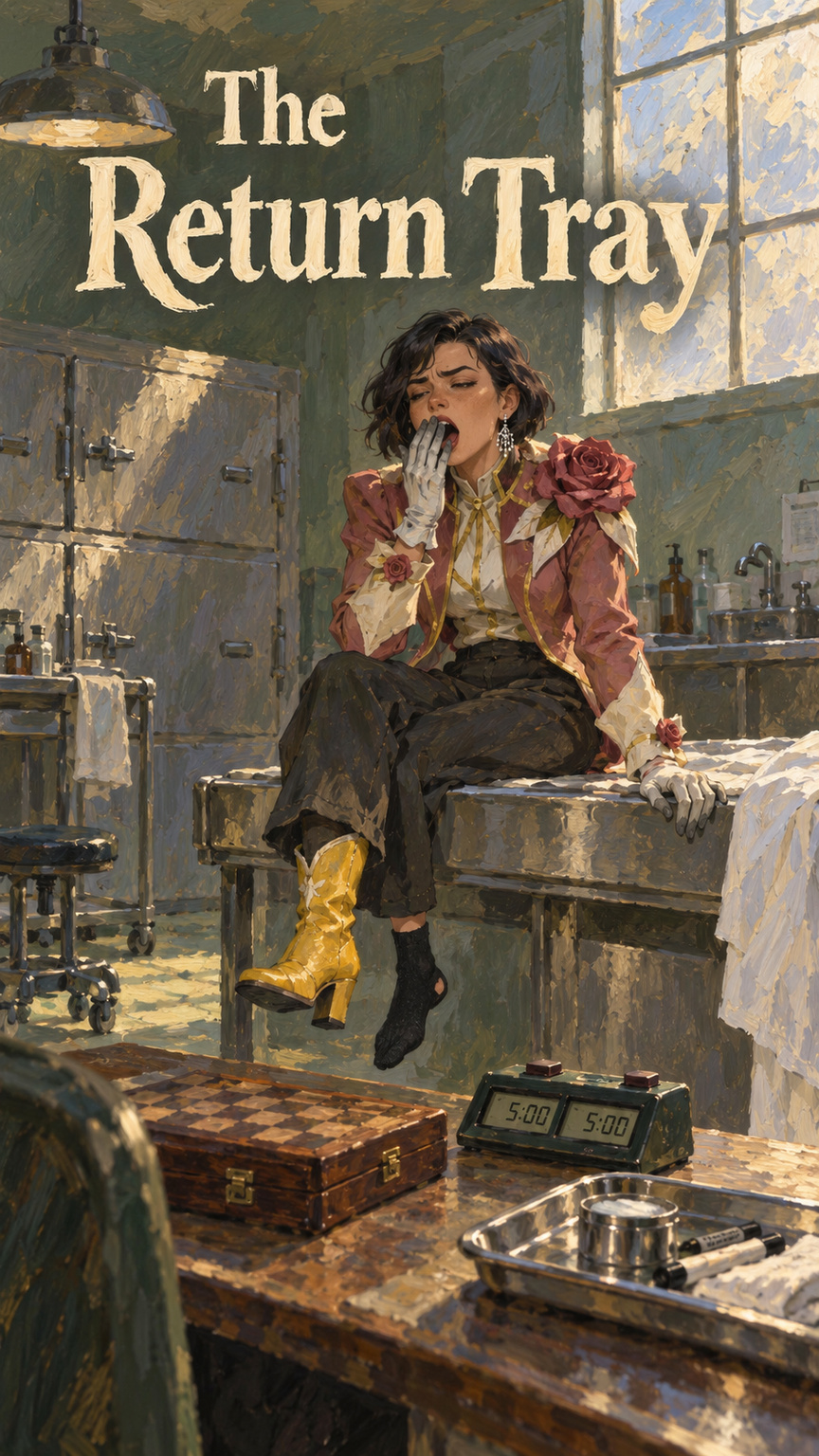
You sigh. Another day, another dead magical girl.
This one is Princess Snapdragon. According to the ambulance sheet, she died saving a tram from a giant moth. According to the property sheet, she arrived with one yellow boot, one silver earring, and a digital chess clock.
You check the bag for the other boot. Nothing. You check beneath the trolley, because the ambulance men have an expansive understanding of the word with. Nothing there, either.
Princess Snapdragon sits up on the slab and yawns. Her arms stretch overhead; the enormous rose on her jacket brushes the light fitting.
You roll your eyes.
“Mind the bulb.”
She lowers her hands and looks at her feet. One yellow boot. One black sock, with a hole at the heel.
“Oh, come on.”
“I checked.”
“It was an expensive pair.”
“Put them in the return spell next time.”
“Then I might come back as a boot.”
“You'd complain less.”
She tests her jaw, rubs the stiff place at the back of her neck, and drops her legs over the edge. The ambulance sheet goes into the drawer marked RETURNED. You have stopped using paper clips. They used to come back for those, too.
Her restoration working, laid down before she went out, takes twenty minutes to finish after her heart stops. It mends the body. Clothes and personal effects are your department. She has explained the distinction to you several times and finds your continued interest in the whereabouts of her left boot needlessly hostile.
You put her earring in the little steel return tray. She hooks it into her ear. Below the dark bob of her hair, it looks like a tiny unfinished chandelier.
“Still cold in here,” she says.
“Still a mortuary.”
“You could put up a picture.”
“You could try arriving somewhere else.”
She slides off the slab, lands on her good foot, and reaches for the chess clock.
“I could beat you.”
“You could try that, too.”
Her civilian name is Leonie. She's twenty-nine, works in a bookshop, and can knock a bus-sized moth out of the sky with a spear of pink light. She has never beaten you at chess. When she first started arriving here, she thought moving the queen early was a declaration of confidence. Later she claimed it had been reconnaissance.
You let her take back one move in that first game. Ever since, she has argued that this established a precedent.
“Get the board,” she says. “I'm white.”
“You're always white.”
“And yet you've never complained when you win.”
You lift the board from the handover tray on the desk. It folds shut, with the pieces held inside by tired elastic. You bought it forty-two years ago for night shifts. You still have the pencil it came with for keeping score, although you stopped keeping score the week Leonie accused you of maintaining a grudge in tabular form.
The tray also holds your spare pens, the stapler which only you know how to open, and a set of labelled keys. Beneath it is the typed sheet for the new attendant. Princess Snapdragon's name appears halfway down the page.
You mean to leave all of it behind when you retire at five.
Leonie puts her clock on the desk.
“Fifteen minutes each.”
You look at the display. “You bought this?”
“I want you to make a decision before the heat death of the universe.”
“You've held up a game by dying twice. And you call me slow.”
“Once. The other time I had a concussion.”
She arranges the white pieces. Her gloves are stained grey at the fingertips, and one flower on her cuff is coming loose. When she turns her wrist, the empty threads scrape over the desk.
“I've been studying,” she says.
“You usually tell me afterward.”
“It makes the disappointment harder to explain.”
She presses your side of the clock to start hers. You sit down.
At the fifth move she offers a pawn you have taken from her at least a dozen times. You leave it alone. She glances up.
“Have you been studying?”
“I was here the last dozen times.”
“Unfortunately.”
You advance a pawn on the other side of the board. She brings out a knight, hesitates, then puts it back.
You raise one finger.
“I hadn't let go,” she says.
You lower it.
There is no more talk for a while. Leonie sits on the stool with her boot braced against the desk leg and her socked foot tucked behind it. The clock buttons click. Outside the high frosted window, somebody tries to reverse a delivery van into the yard. They fail, pause, and fail in a different way.
Your next move makes Leonie smile.
You dislike the smile. It isn't her usual smile, which announces that she has thought of something unkind to say. This one hardly moves her mouth at all.
She puts a bishop where it cannot possibly be comfortable.
If you take it, her knight comes in with check. If you leave it, her queen follows it down towards your king. You examine a third possibility, advancing the pawn in front of your rook. Six moves later in your head, it ends badly.
Leonie watches you count.
You push your bishop between hers and your king, offering an exchange.
She takes it without hesitation.
You recapture. Her queen moves in. You have lost the protection you wanted to keep, but the immediate attack has slowed. Barely.
“Did you learn that at the shop?” you ask.
“Lunch breaks.”
“Sell fewer books.”
“I bought them myself.”
She has a knight and queen pointed at your king. Your rook is stranded behind three pawns. You move it along the back rank and let go. She pushes a pawn forward, shutting the route you meant to use. You wish you had left the rook where it was.
Her smile gets larger.
At five o'clock, Mr Coyle puts his head around the door.
“All yours,” you tell him, and stop the clock.
Mr Coyle nods at Princess Snapdragon. She gives him a little wave.
You hand him the keys. The last entry is signed; the cold-room count is done; there are no families waiting upstairs. You show him which drawer sticks and where the duplicate certificates go. He reads the first page of your sheet.
“Magical returns,” he says. “Right.”
“They're usually hungry.”
“Don't buy the coffee,” Leonie says. “It's dreadful.”
“I told you that before you bought it,” you say.
“I thought it was a psychological tactic.”
Mr Coyle takes the handover tray, then pauses with the board still on the desk.
“Does that come with the room?”
“Yes,” you say.
Leonie looks from him to you.
“The chess set,” you add.
“I did think that,” says Mr Coyle.
You unpin your name badge and lay it face down in the tray, beneath the stapler. You have been wearing it for so long that the left lapel feels unusually light. You put on your coat.
“It can go in the cupboard when we're done,” you tell Leonie. “Mr Coyle plays. I asked.”
“How well?”
“How well do you play?” Mr Coyle asks her.
“That's currently under review.”
He takes the tray into the little office. A moment later you hear him testing the stapler.
Leonie picks at the loose flower on her cuff. The last thread parts. She rests her thumb on your clock button.
“So this is your last day.”
“I told you I was retiring.”
“You told me you ought to retire. That's different. I've told you you ought to retire every time you take my queen.”
You said it more plainly in June, but she was looking for a pair of spectacles which had not survived a collapsed theatre roof. You cannot now remember whether you waited until she found the broken frames.
“Well,” you say. “It is.”
She looks at the cupboard, then back at the board.
“I spent three Saturdays on that attack.”
“It shows.”
“I didn't spend them on Mr Coyle.”
You still have your coat on. At the bus stop there will be a few other people finishing work. You have looked forward to standing among them without a telephone which can send you back here.
On the board, her queen waits for you to be careless.
“Do you want to finish?” you ask.
“I want you to start your clock.”
You take off your coat. Instead of hanging it on the hook, you fold it over your knees.
“One thing first.”
“If this is about taking back your rook move, no.”
You find a loose half-sheet on the desk. For years she has arrived, complained, played, and left. You know how she takes her coffee and which side of her jaw aches first after restoration. You know she will blame the overhead light when she overlooks a fork. You have never had to give her directions to you.
You write down your address.
“I don't have a table this high,” you say. “But there's room.”
She reads the paper. You have written the street number twice, once above the street and once beside it.
“Is that a house or a score?”
You cross out the second number.
“Sundays,” you say. “If you're free. Four?”
“Is this going to influence my assessment of that rook move?”
“I had hoped.”
She folds the paper into the palm of her glove, with the little flower that has come off her cuff.
“I'll need the board,” she says.
You go to the office door and tell Mr Coyle it no longer comes with the room. He has the stapler open already. You could resent that, but there are other things requiring your attention.
Leonie presses the clock. You sit down to save your king.
You have to bring your queen back to protect your king. Then she advances a pawn to keep the attack moving and leaves your queen a route to check her king.
You check the route twice, then move.
She sees what you saw as soon as you move. Her hand comes forward, hovers over the pawn, and stops.
“You let go,” you say.
“I know.”
She makes you play another eight moves. One of them nearly costs you the queen.
At five fourteen she tips her king on its side, stops the clock, and lies face down on the empty slab.
“Don't be dramatic,” you say. “I've got to fold the board.”
“I prepared for that.”
“You prepared for me to take the bait. I didn't.”
She lifts her head. “You looked at it for ages.”
“It was a lovely bishop.”
“I could have taken a bus here, watched you consider that bishop, gone out and fought the moth, and been back before you finished admiring it.”
You put the pieces away. Your fingers are steadier now. The late bus will get you home well enough.
Leonie sits up and holds out her clock. You look at it, then at her.
“Just put it inside your coat,” she says. “I've got one boot. I need my hands for the railings.”
You tuck it away with the board. She checks the folded address in her glove, rubs her bare heel, and hops towards the door.
“Sunday,” she says. “And I'm still white.”
“Mr Coyle might let you be white.”
She looks back at you.
“He might take the bishop.”
On Sunday you move the vase off the kitchen table and put the board where both chairs can reach it. The overhead lamp casts a shadow across the white side. You switch on the lamp above the counter instead.
At ten to four you check the clock. You press each button, in case there is some fault which has developed while it has been in your possession. There isn't.
At five to four you put a biscuit on each plate. At three to four you put another biscuit on hers, then another on yours so it does not look like a concession.
The doorbell goes at four exactly.
Leonie is wearing a green coat and two scuffed trainers. Both silver earrings are in place. There is a paper bag under her arm.
“You're punctual,” you say.
“You look disappointed.”
“I wondered if something had happened.”
“I work Sundays. I swapped.”
You stand aside. She leaves her trainers neatly by the door and comes through to the kitchen. There is no heroic rose on her shoulder, no soot, no need to check anything before she sits down.
She looks at the board, at the clock, and at the two chairs. You have put a cushion on hers. She moves it to yours.
“You can remove that before we start,” you say.
“It's for when you lose consciousness waiting for me to make a mistake.”
From the bag she takes a new chess book, bristling with paper markers.
You sigh.
She opens it at a marked page, lowers her voice, and points to a photograph of a man with a magnificent beard.
“Dead,” she says. “And look how many games he won.”
You roll your eyes and reach for a black pawn.