
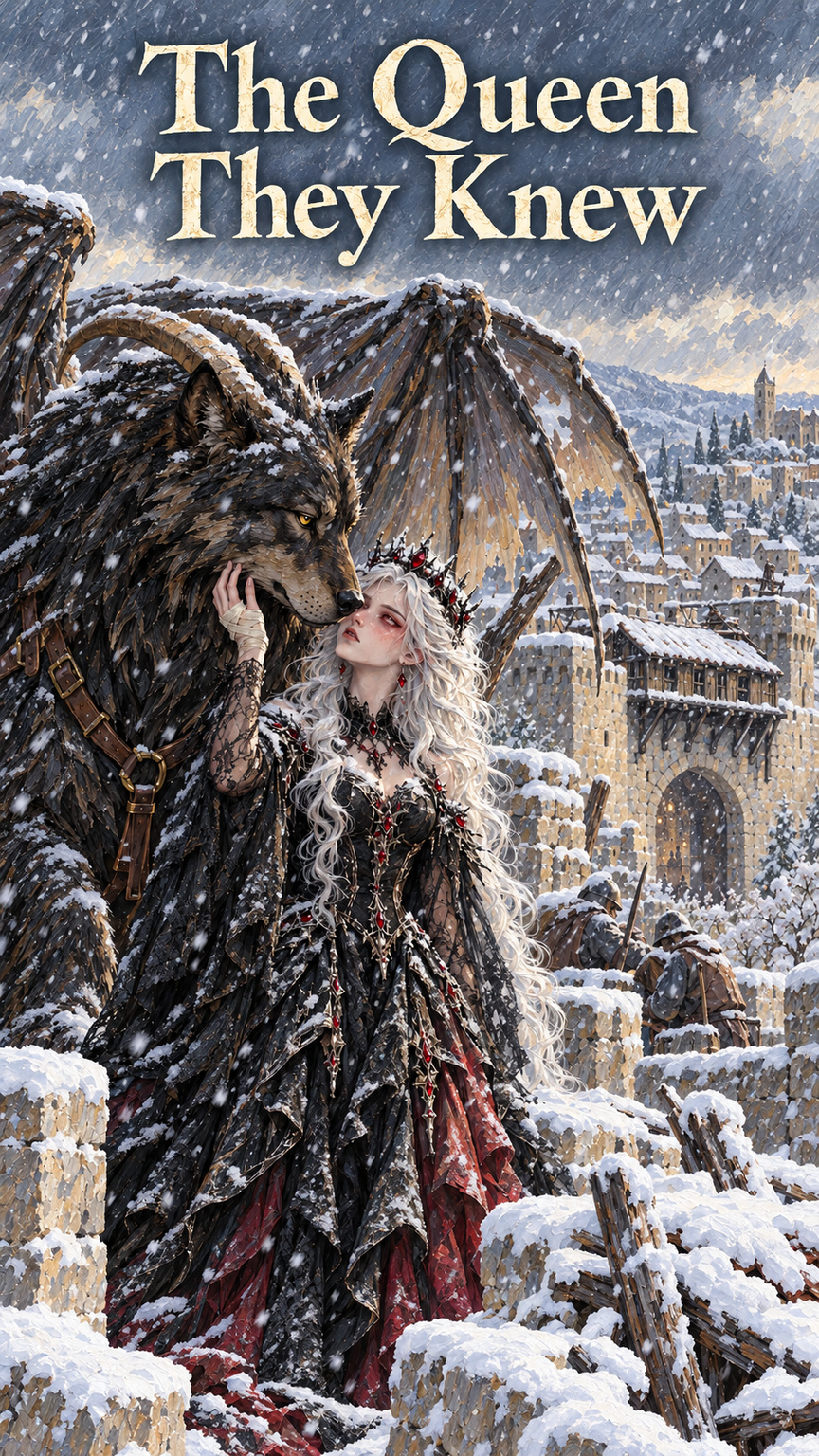
For six days, Orsane heard how happy everyone was that her mother was dead.
At the southern ports they gave away wine. Inland, a woman stood outside a posting house with the names of her missing sons pinned to her coat, laughing so hard she could scarcely breathe. Soldiers came down the north road without their badges. Some had deserted; some said there was no army left to desert. Their generals had fled with the pay chests when the Dark Queen fell.
Orsane bought a horse. She joined in one toast. She found that she could be glad and still wake at night with something unfinished to say.
Snow had begun on the warm southern evening the messenger found her. By morning, it lay thick on the inn's courtyard. It fell at the next town too. From a hill beyond that town she had looked back and seen sunlight on the roofs, while the white cloud moved with her along the road. Her mother's winter had passed to her without asking what she wanted.
On the seventh day she entered her mother's forest.
Snow still loaded the firs, but it had begun slipping from the branches in heavy, wet falls. A brown run of earth showed through the road. Beside it, the stump of a cursed tree put out a single green shoot.
Fresh snow filled the hoofprints behind her. Beyond the falling white curtain, the farther hillside ran dark with thaw.
She dismounted to look.
The horse screamed.
Vask came between the trees, folding his wings to pass. Black fur brushed the trunks at either side of him. His horns swept back over his shoulders, and his yellow eyes were level with Orsane's head even before he straightened his forelegs.
He had carried her on his back when she was small enough to sleep between those horns.
She put a hand over her horse's eyes. With the other she caught Vask's lowering muzzle.
“You still smell of snow,” she said.
“You smell of foreign soap.” His breath stirred her white hair. “We have waited a long time.”
“I didn't come back for her.”
“No, Majesty.”
Far away, a bell began to ring. Vask's ears turned toward it.
“They've been doing that for days,” Orsane said.
“My sister will stop them.”
“I like bells.”
He considered this. “Then we shall make them continue.”
She looked up at him. Twelve years away, and he still made it possible for a person to be cruel simply by enjoying a sound.
“Nobody is to be made to do anything about bells.”
Vask lowered himself. She could have stepped from the road onto the broad place between his wings. As a child, she would already have been climbing.
“I have a horse,” she said.
He walked beside her instead.
There had been creatures near her lodgings on the journey north. Once, at dusk, every dog in a village had crawled under something and stayed there. At an inn, she had found a huge print in the kitchen garden, close enough to the back door that the cook must have stepped inside it on her way to gather herbs. Orsane had left before breakfast. The next night the print appeared outside a different inn.
“You found me at the coast?”
“At the second posting house. I went ahead to the crags and told Leth. The others are waking.”
“I thought they might follow me.”
“Always.”
He said it with such love that she had to look at the road.
The old blood-binding required them to keep her alive. It gave her no power to make them obey. She had come north to put a throne and castle walls between that devotion and the people she had lived among. She was beginning to doubt that walls would be enough.
By the time they reached the castle, the road was white again. Old drifts banked the northern walls; fresh snow blew across the courtyard and gathered on the unshovelled steps. Leth lay along the gatehouse roof. She was pale where Vask was black, with the same great wings and backward horns. She lifted her head when Orsane passed beneath her.
“Little thorn.”
Orsane stopped. Her mother had called her that; Leth had made it affectionate by saying it with a whole apple balanced on her nose.
“Leth.”
“Your crown is waiting.”
“I don't want her wars.”
The pale creature's lip lifted from her teeth. “Of course. You shall have your own.”
Inside, the servants had taken down the banners and had not known what to put in their place. Bare rectangles marked the walls. Someone had washed the throne room, but a scorch reached from the foot of the dais to the broken western windows. Snow drifted through them onto the blackened stone. Servants stood with their hands tucked beneath their arms, watching it settle.
Her mother's crown rested on a cushion, black thorns set with red stones. Orsane put it on. One of the points caught in her hair.
Marshal Harnet watched from beside the doors. He had come that morning to meet the reported heir.
He had surrendered his weapons to the castle steward. His right hand was bandaged, two fingers stiffly splinted. He looked less like the man who had ended a reign of terror than a tired guest who had arrived before his room was ready.
“Your face,” he said, then stopped.
“Yes.” Orsane freed the caught hair. “I'm told the resemblance is considerable.”
“I had hoped the reports about a daughter were wrong.”
“I hoped a great many reports about my mother were wrong. Come in.”
He came as far as the scorch.
Orsane sat on the throne. She had imagined that doing so would feel like an answer to something. The stone was cold through her black skirts.
“I am Orsane, her daughter. I claim the throne.”
Harnet's jaw tightened.
“And I want a ceasefire while we discuss what that means.”
“The kingdoms are meeting in my capital in three days. If you send an envoy—”
Vask moved.
Harnet struck the floor before Orsane could rise. One enormous forepaw covered his chest. Vask bent to smell him.
“You held her.”
Harnet tried to draw breath.
“Vask.”
“You held her while the swords went in.”
For a moment Orsane could think only of his hands on her mother's wrists.
Orsane ran down the steps and put herself between his muzzle and the marshal. Vask drew back so quickly that his horns scraped the wall.
“Lift your foot.”
He did, though he kept it over Harnet.
“He came under truce.”
“I understand.” Vask's voice softened. “You wish to keep him.”
She knelt. Harnet pushed her hand away and got to his elbows himself.
“I wish him to go home alive.”
Vask glanced toward the western windows. “That may distress you.”
Outside, the gatehouse roof was empty.
Orsane stood slowly.
“Where is Leth?”
“West.”
Harnet looked up.
“I told her your blood was home,” Vask said. “She asked whether the kingkillers still had their city. I said they did.”
“Call her back.”
“She is beyond hearing.”
“Then call the others.”
“They went with her.”
Orsane stared at him. “You knew I wanted peace.”
“Yes, Majesty.”
“What do you think peace is?”
His ears sank a little. He seemed hurt to be asked something so elementary.
“No one left who can hurt you.”
Harnet made a short sound. He was trying to stand.
“How many?” he asked.
Vask did not look at him. “Enough.”
Orsane reached for one of the straps of the old riding harness still hanging beneath Vask's folded wing.
“Take me there.”
He recoiled. “They will finish before evening. There is no need for you to see—”
“I am going. You can carry me, or you can watch me take the horse.”
For a moment she thought he would put a paw over her too.
Harnet caught the second strap.
“I'm coming.”
“You can barely stand,” she said.
“They won't lower a bow because you ask them.”
Vask looked from one to the other. Then he lay down.
They flew west over the thawing forest, beneath a low white cloud that kept pace with them. When Vask banked, the snowfall banked with Orsane. It whitened his back and streamed behind his wings, laying a fresh swathe across the brown breaks in the woods. Beyond that moving winter, the thaw continued.
Orsane's skirts snapped against Vask's flanks, black lace over dark red. Cold pinched her bare shoulders. Harnet clung behind her, his breath white beside her cheek. Below, people moved along roads that had been closed for a generation, carrying bundles and pulling handcarts toward the western valley.
She had met one of those families the previous day. A man had shown her an iron key and said he was going to find out whether his front door still existed. He had asked if she was going home too.
She had said yes.
Vask turned his head far enough for one yellow eye to find her.
“You needn't be afraid.”
“I am afraid for them.”
He looked down at the moving dots.
“I know,” he said gently.
That gentleness frightened her more than his teeth.
“You don't know. You think I'm saying it because he's listening.”
Harnet's grip tightened on her belt.
Vask flew on.
“Do you remember the fox?” she asked.
His wings changed their beat. “In the south courtyard.”
“I asked you to let it go.”
“Your mother let it reach the gate before she loosed the hounds.”
“I was eight.”
“You hid beneath my wing.”
“I was crying.”
He was silent so long that she thought the wind had taken the words.
“She said you were laughing,” he said at last.
Orsane remembered his fur against her mouth. She had been trying to be quiet. Her mother had grown so angry when she cried in front of guests.
“You could feel me shaking.”
Vask's head turned forward again.
“I could feel you,” he said.
The western valley opened beneath them.
Smoke rose from an orchard outside the capital. The eastern gate stood open for the people hurrying in from the road. On the towers, little figures wound the great bows.
Above the city wheeled the creatures her mother had kept for difficult sieges.
Orsane had never seen so many in daylight. Some had shapes she could name. Others made her eyes search for missing pieces of familiar animals. They circled the roofs, keeping the city under their shadows.
Leth had landed on the eastern gatehouse. Men ran from beneath her feet.
“The wall,” Orsane said.
Vask banked away.
She hauled on the harness. It was like trying to steer a hill.
“The wall, Vask.”
“There are weapons.”
“And people. Put me beside them.”
An arrow struck his shoulder and vanished into the fur. Harnet rose against the straps, shouting his own name.
The snowfall reached the eastern wall with them, sweeping over stones that had been bare a moment before. Vask landed hard on the wall walk beside the gatehouse. Stone broke beneath his claws. A young soldier stared at the crown through the falling white, then aimed a crossbow at Orsane's face.
“Stand down,” Harnet said.
“Marshal—”
“Look at me. Stand down.”
Orsane slid from Vask's back. Her knees nearly failed. She gripped the parapet until she could trust them.
Across the gap in the wall walk, Leth lifted her head.
“Little thorn?”
“Stop the attack.”
Leth's gaze moved to Harnet, then to the crossbow still shaking in the soldier's hands.
Her wings opened.
“They have you.”
“I came here.”
Leth screamed. Across the city, the creatures turned from the roofs and towers toward Orsane at the gate.
“Back!” Harnet pushed Orsane against the parapet and raised a discarded shield over her. Something struck it hard enough to drive him to one knee. Above the rim, she saw a hooked foot withdraw into the sky.
The soldier with the crossbow began to sob. He lowered the loaded bow, unable to hold it steady.
“I've made it worse,” Orsane said.
Vask thrust his head between her and the sky. “Get on.”
Beyond his shoulder, Leth crossed the broken walk in one jump. Her pale forepaw closed on Harnet's shield. She ripped it away.
“No,” Orsane said.
Leth reached for him.
A short sword lay against the parapet. Orsane snatched it with both hands and drove it into the crease above the reaching claws.
The shock went up her arms. Leth shrieked. The blade twisted out of Orsane's grip, opening her palm, and clattered down the steps.
Leth stared at her.
Orsane put her bleeding hand on Harnet's shoulder.
“You leave him alone.”
“What have they done to you?”
The pale creature's voice was almost tender.
Vask caught Orsane by the back of her dress. She felt the cloth tighten beneath her arms, felt her heels leave the stone.
“Put me down!”
“I can get you clear.”
She caught his lower jaw with both hands, just as she had on the forest road.
“You can get me clear,” she said, breathless. “Then what?”
He held her above the walk. Snow gathered on the black lace stretched between his teeth.
She could see it in his face: the flight home, the closed doors, his wing over her while the city screamed. He would keep every sharp thing away from her. He would be so gentle.
“I won't go with you.”
His grip loosened. Her feet touched stone.
“They held your mother,” he said.
“I know.”
“They killed her.”
“I know.” Her injured hand slipped on his jaw. She held on with the other. “Help me keep them alive.”
His eye was close enough for her to see herself in it, small beneath the crooked crown.
Leth struck at Harnet over Orsane's shoulder.
Vask's wing came down between the marshal and her claws. They pierced the membrane. He made a sound Orsane had never heard from him, then shoved Harnet and the young soldier back beneath the wing's great ribs.
Leth climbed onto the gatehouse roof to reach around him.
“Move, brother.”
Below the arch, a cart overturned. People were pressed shoulder to shoulder there. Orsane saw an iron key swinging from a man's neck as he tried to lift a child above the crush.
A roof beam split beneath Leth's forefoot.
Vask braced his shoulder under the sagging eave before it could fall into the packed arch. The movement opened his throat to her.
“Let me take her,” Leth said. “You can keep those two when we've finished here.”
Orsane looked up at the pale muzzle. Leth had once held an apple there until an impatient little girl stopped crying long enough to laugh.
“Leth. I am staying.”
“You do not know what you want.”
Orsane stepped beneath the reaching paw. It stopped above her hair. Leth lifted it over her and hooked the eave farther along, beyond Orsane's reach. Tiles slid into the gateway. The man with the key bent over the child.
“Vask,” Orsane said. “Kill her.”
He did not move at once.
Leth looked at him. Their horns almost touched.
Then he heaved the broken eave outward and lunged. His jaws closed on Leth's throat.
Orsane dragged Harnet back. The roof tipped away from the gateway and spilled down the outer face of the wall. Vask and Leth went over with it. A white wing beat once above the parapet.
When Vask rose, he rose alone.
Leth lay in the road beyond the carts. Her head was at an angle it had never taken in sleep.
Vask looked down at her. Orsane waited for him to turn on her. It seemed impossible that he should carry that face back to her and do anything else.
He landed on the broken gatehouse, facing outward.
The sky came down on him.
“Under his wing!” Orsane shouted.
Harnet caught the young soldier by the collar and pulled him into shelter. Orsane snatched up the fallen shield. A narrow head darted between two of his wing's great ribs and she struck at it with the shield's edge until it withdrew.
Vask could not spring without exposing the people below him. He fought where he stood, tearing one attacker out of the air, hurling another toward the empty slope. A third landed beside Orsane. It looked from her shield to the dead white shape below the wall.
“They hold you?” it whispered.
She shook her head.
It stretched its neck toward her, offering its back. She did not climb on. After a moment it edged away, then launched itself from the wall and did not return.
The others kept coming.
Orsane found a gap beneath Vask's torn wing and pointed through it.
“Vask, throw the creatures east, over the orchard. The carts are clear. Harnet, the stairs—”
“I see them.”
He sent the soldier down to bring up the spears. Orsane held the shield over Vask's exposed foreleg while he turned. She could not tell how much time passed. Her arms shook; each blow knocked the iron rim against her crown. Snow crusted the handle between her stiffening fingers. Once Vask stumbled, and hands she did not know reached out beside hers to hold the shield in place.
The spears came up. Men who had been trying to kill him less than an hour before stood beneath his wings and stabbed at anything that came through.
A blunt-headed creature settled on the parapet and opened its jaws wide enough to take the sheltering wing. Orsane raised herself behind the shield. The jaws checked. It could not bite through to the men without taking her too.
It thrust its snout into the narrow gap beneath the wing instead. A spear caught in its jaw. It recoiled, wrenching the shaft from the soldier's hands, and climbed into the air with the wood still hanging from its mouth. Once it circled back. Vask waited, his wing braced against the stone, spear points beneath it. The creature turned toward the forest.
Another followed. The next tried the same gap and was driven back. Those still circling began making single, wary approaches, testing for a way past Vask's teeth and the spears.
At last there was room between the shapes in the sky. Then there were only a few, circling beyond the bow range. One by one, they went toward the forest.
Vask stayed facing outward until the last had vanished.
Orsane set the shield down. She could not make her fingers let go of its handle.
Harnet prised them loose.
“Not your sword hand?” he asked.
She laughed once, painfully. “I don't have one.”
He took a strip of cloth from his coat and bound her palm. Neither of them looked over the wall.
Below, people were being carried away from the gate. Others knelt in the trampled snow calling names. The man with the key stood holding the child, staring at the ruin that had missed them.
“This doesn't buy you a kingdom,” Harnet said.
“I have one.”
“It doesn't buy you peace.”
“Will you give me a day?”
He looked at Vask's ruined wing. “A day.”
She went to Vask.
He stood with his head hanging beyond the parapet. She rested her forehead against his cheek. He did not lean into her as he once would have done.
“You asked me to kill her,” he said.
“Yes.”
“I heard you.”
Orsane shut her eyes. Beneath her hand his fur was warm, and the muscles in his jaw would not stop trembling.
They stayed on the wall through the night. Vask would not leave it, and Orsane would not leave him. Snow banked against the broken parapet and lay deep on the gatehouse ruins. The people still sheltering beneath his wing pressed closer to his warm fur; Orsane made room for the young soldier beside her. She slept briefly against Vask's foreleg, waking whenever someone was brought up the stairs to ask whether the monsters would return.
At dawn, snow was still falling around them. A bell rang inside the city.
Vask's head came up. His good wing opened. Orsane felt the people sheltering beside them go still.
Then he turned and looked at her face.