
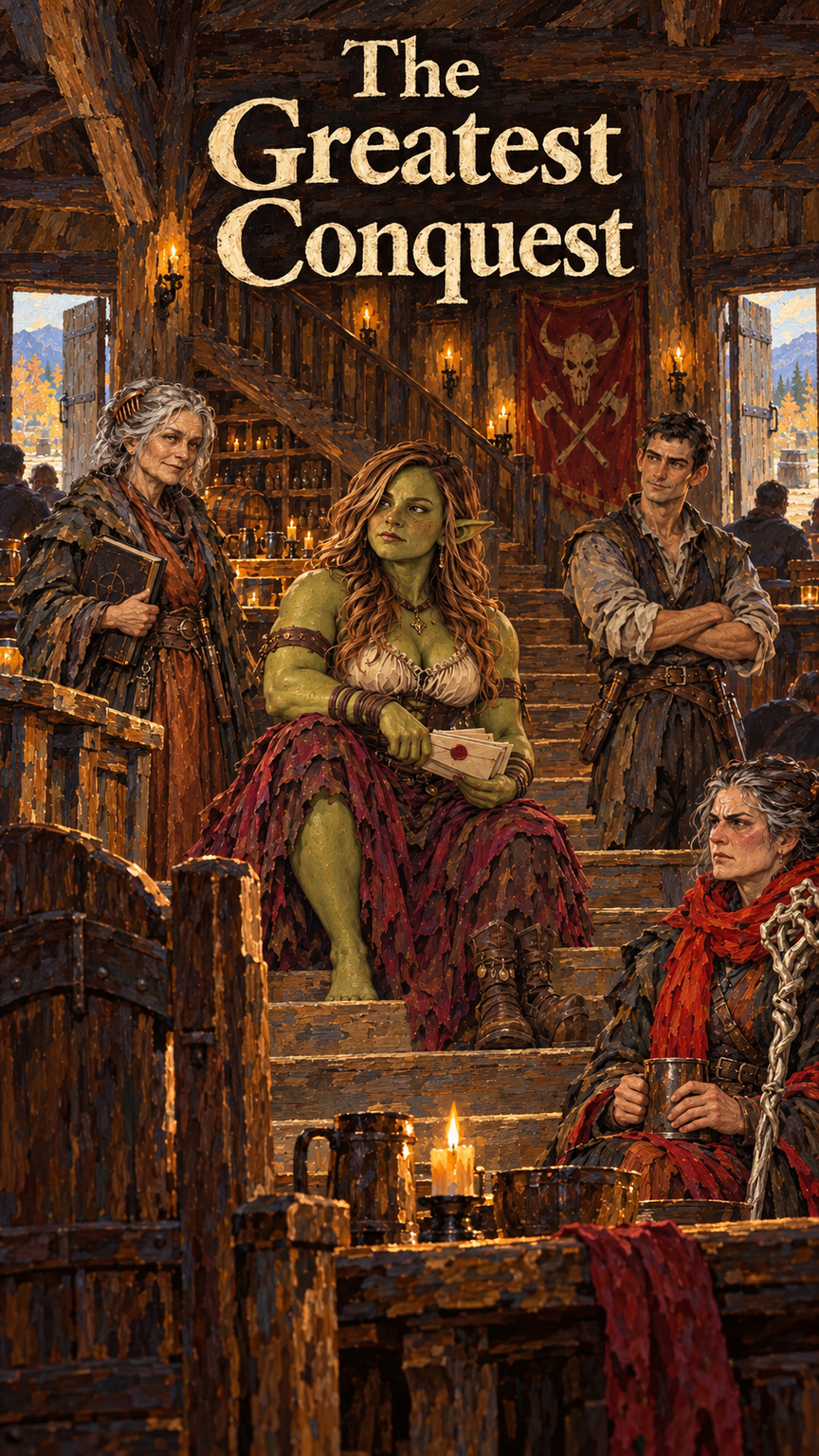
At the toll post, the knight read Harka's deed twice, then turned it over to look for the trick.
“Your father owned a tavern?”
“Apparently.”
“Here?”
She waited. He glanced from the seal to her green hands.
“You'll find we're particular about who serves decent people.”
“I'm selling it.”
“Sensible.” He held the parchment just beyond her reach. “Keep to the main road. No wandering through the farms.”
Harka took it from him. He had expected her to stretch up; he hadn't expected her to step forward.
She had allowed a week for finding a buyer. Perhaps she could manage it in three days.
Beyond the post, the road forked around an orchard. Fresh wheels had cut deep into both branches. Heavy wagons going uphill, though the barley harvest was over. She looked at the ruts, at a strip of white cloth snagged on a thorn, and then at the knight pretending not to watch her go.
She loosened the knife at her hip.
The tavern stood alone where the branches met again: a sprawling timber building with a sagging stable, a crooked chimney, and a red banner hanging limply from the upper window. On it, a horned skull grinned above two crossed axes.
Her father's banner. Of course he had put it on a public house.
The smaller sign said GOOD ALE. GOOD TALES. Someone had painted over GOOD BEDS.
Harka tied her mare beside an old black carriage. A sword hilt protruded from its luggage. So did a shovel.
Inside smelled of woodsmoke, onions, and wet wool. Candles leaned in their sockets. A stair climbed along the wall behind the bar, its middle steps worn pale. Twenty or thirty people had gathered around the tables, some dressed for a funeral, some for quite different emergencies.
They all stood up.
Harka stopped with the deed in her hand.
“Chief,” said a thin man by the hearth.
She knew him. Not personally. There had been a woodcut nailed to the gate of every town she had entered for the last six years. The artist had given him a villainous beard, but the right little finger missing at the second joint was correct.
Veyr. Two thousand crowns alive. Considerably less with proof.
“You've mistaken me for someone,” she said.
“No.” He inclined his head. “My condolences.”
At the next table, a broad woman in a scarlet scarf put down a cup. Harka recognized the silver staff laid beside it, its head an elaborate knot of finger bones.
“You,” the woman said to Veyr.
He turned. “Dame Cadrel.”
“You were told to use the west door.”
“I did. You were told to face the east wall.”
“I have been facing the east wall for eleven years.”
The candles bent towards Cadrel. Under the table, something scraped along the floor.
“Sit down,” Harka said.
It came out in the voice she used when recruits spotted their first enemy and all tried to stand on the same hill.
Cadrel sat. Veyr sat. The scraping stopped.
Every face turned back to her.
An elderly woman near the bar closed a black book. She wore copper combs in her iron-grey hair and a travelling coat too warm for the room. Something about her yellow eyes made Harka wish she had brought a longer knife.
“You must be tired,” the woman said. “Sit where you please. Your father had the big chair, but it does squeak.”
“Where's the keeper?”
“You've just arrived.”
Harka looked around the room again. A woman with the brand of the king's disbanded Black Company on her cheek. A hooded man whose shadow had antlers although his head did not. At the back, the supposed dead duke of a province Harka had been paid not to enter.
There were enough rewards in this room to purchase a small fort.
“Igrith,” the elderly woman said.
Harka's hand closed on the back of a chair.
Igrith had burned the royal summer palace while the king's grandfather was still in it. People used the foundations as a quarry now.
“You're a dragon.”
“Yes.”
“You're all—”
“Hungry,” said the dead duke. “But we thought we ought to wait.”
Harka put the deed on the bar very carefully.
“I need someone to explain what my father has left me.”
“We hoped you could tell us what to do about the soldiers,” said Igrith.
Borzug had bought the tavern thirty years ago, after his famous defeat of the king's western army. Harka knew the battle. Every orc child knew it: the broken royal standard, the surrendered swords, the chieftain who had ridden through a burning gate with his beard on fire.
She had not known he subsequently spent four days arguing over the price of the inn.
“He wouldn't pay for the stable,” said Igrith. “He'd burned half of it down.”
“And this?” Harka gestured at the company.
“Came later.”
Some came to buy back captives. Some came to sell information. A defeated general could meet the woman who had defeated him, hire a different army, and leave by another door. No one touched another guest under the roof. Anyone who tried was put outside, where Borzug waited.
Eventually people began coming without any business beyond a meal somewhere their enemies could find them and do nothing about it.
“The Crown?” Harka asked.
“Your father and the old marshal understood one another,” said Cadrel. “The Crown pretended not to know who drank here. Borzug pretended not to know where the Crown's informers sat.”
“Third table by the window,” Veyr said. “One of them had a lovely tenor.”
Harka looked at him.
“He retired.”
“And now?”
Igrith opened the black book. The pages were crowded with names, some scarcely more than scratches, some accompanied by elaborate seals.
“We agreed to keep the peace here and follow Borzug's direction in defending it. Including the direction of the successor he named. Otherwise the first person who outlived him could take the place from everyone else.”
“He named me.”
“Last winter. At that table.”
Harka looked at the empty chair. For a moment she could hear his voice filling the room, his certainty making dissent seem something that would happen later, elsewhere, when he wasn't busy.
He had used that voice with the mountain envoys fourteen years ago. The pass would open in spring. Harka would marry their chief's son at midsummer.
She had told him no. In front of everyone.
Borzug had put a hand on her shoulder and told the envoys not to mind her. She would come round.
By morning she was four miles beyond the clan boundary, carrying a blanket and a knife. She had earned the mare later, and the boots, and the right to tell a captain when he was wrong about a road.
She pushed the black book away.
“I didn't agree to any of this.”
“We know,” said Igrith.
“You could have sent a letter.”
“We told him.”
That answer was worse than an excuse.
Harka picked up the deed. “Then I can leave.”
“Certainly,” said Veyr.
“And you won't stop me?”
He looked faintly offended. “You are not a prisoner.”
The dead duke began putting on his gloves. Someone near the hearth drew a cloak around a sleeping companion. Cadrel folded her scarlet scarf and tucked it inside her coat.
“What happens to you?” Harka asked.
“I go north,” said Cadrel. “He follows.” She nodded at Veyr.
“Not immediately,” he said. “I have other work.”
“I burn this place,” said Igrith. “After everyone leaves. There ought not to be a royal garrison here.”
She said it without looking away from Harka, in the same mild voice she had used about the chair.
A knock sounded at the open door.
The knight from the toll post stood outside, carrying a white cloth on the end of his spear.
“Lord Othred, western marshal of His Majesty's forces, wishes to speak to the daughter of Borzug.”
“Here she is,” said Harka.
He saw past her. His spear dipped.
Veyr raised his cup in greeting.
The marshal waited on horseback at the orchard's edge. Harka went out alone.
There were sixty men drawn up across the road and two stone-throwers behind them. Men carried bundles of pitch-soaked brushwood towards the machines. A royal standard stirred above the marshal's white plume.
He had come prepared for a wooden building full of people.
Harka stopped where a low fence gave her a view along both branches of the road. On the western one, the tracks she had noticed disappeared through an opening in the orchard wall. The visible stone-throwers had come by the eastern branch.
A tarpaulin lifted among the trees. Under it she glimpsed two enormous paired bows, each mounted on a wheeled frame. Bolt-throwers. Their crews pulled the covering down again.
“My condolences,” said Othred.
“Popular words today.”
He was a lean man with a weathered face and a voice trained to carry without sounding loud. He passed down a document.
It offered eight hundred crowns for the estate. Below that, under his own seal, was a guarantee of safe passage south for Harka, her horse, and her possessions. All other occupants would remain for arrest.
“You have no part in their crimes,” he said. “Your father's quarrel with the Crown need not become yours.”
“And if I refuse?”
“The property will be seized. Today.”
His men could hear. He wanted them to.
“The old marshal left it alone.”
“The old marshal left many things unfinished. I have a new appointment and a royal warrant.” He drew a second paper halfway from his saddle case. “Every outlaw in the kingdom seems to have come to the funeral. An opportunity like this will not recur.”
Harka looked at the stone-throwers. “There are rooms upstairs.”
“They will be invited to surrender.”
“And the brushwood?”
“An encouragement.”
She folded the offer.
Othred studied her for a moment. “Take the south road. My men will let you through. You have until the bell.”
At the tavern she untied her mare. The south road lay clear, descending between the harvested fields. She could pass the toll post before they finished loading those machines.
Through the open door she saw Cadrel rolling up a map. Veyr was checking the latch of the west window. Neither looked towards her.
If she stopped the seizure, she could still sell tomorrow.
She had been given a horse once before, for a journey someone else had arranged. A good horse. A wedding gift. She had left it in the stable.
This mare turned her head and blew impatiently against Harka's wrist. Harka had bought her with three seasons' pay. She could ride her anywhere.
She retied the reins.
Inside, Igrith was putting away the book.
“I'd like to know what each of you can do,” Harka said.
The dragon's yellow eyes brightened.
“Be specific,” Harka added. “I already know you can make this much worse.”
“There are two more engines in the orchard,” she told them. “And another body of men. Those on the road are meant to draw you out. The ones under cover will shoot into your flank.”
Igrith had unbuttoned her coat. Under it she wore a dress the colour of old copper.
“It has been some time since an arrow troubled me.”
“These are engines, not bows. They brought something they believe will trouble you. Can you get behind them?”
“Yes.”
“Without flying straight over the road?”
Igrith smiled, and Harka saw how little of the woman belonged to the smile.
Cadrel leaned on her staff. “The orchard was a battlefield before it grew apples. I can reach it from the fence.”
“How many?”
“Enough.”
“Keep the soldiers off their feet. Let them breathe.”
Cadrel's fingers stopped moving on the silver shaft.
“Othred commanded at the burning of my tower,” she said. “I know how he encourages surrender.”
“We need his men alive to walk home and tell people what happened.”
“We don't need him.”
“I do. Veyr will bring him.”
The assassin looked up from tying back his sleeves.
“Alive,” Harka said.
“He will be loud.”
“Then bring him loudly.”
Around them, the others listened. Harka put the Black Company woman in charge of keeping the yard clear. The dead duke had four loyal men who, remarkably, had not even pretended to die with him. They took the kitchen door and the stable. The antler-shadowed man listened to something no one else could hear, then told Harka there were indeed men among the trees.
“Tell me when they load,” she said.
He nodded.
Cadrel had not moved.
Harka faced her. She had commanded frightened people before. She had commanded exhausted people, and once a man whose brother had just died. She had never commanded someone who could reach into a battlefield and lift its dead.
“Can you do it?” she asked.
“You ask for the difficult thing.”
“Yes.”
Cadrel's staff tapped once against the floor.
“Then you had better give your signal clearly.”
Outside, a soldier on the road began ringing a bell.
Igrith went out through the kitchen, shedding her coat as she walked. The duke caught it. A moment later the chickens in the yard began making a terrible noise.
Harka took her place at the fence. From here she could see the marshal and the gap in the orchard wall; Cadrel, standing in the doorway, could see her.
The toll knight called the invitation to surrender. Harka let him finish. She wanted the men on the road looking towards the tavern.
Behind the trees, branches broke.
“They are loading,” said the antler-shadowed man.
Harka raised her arm.
Cadrel's free hand opened. The orchard soil heaved.
A soldier shouted. Beyond the wall, ranks broke apart as pale hands closed around ankles and dragged men gently, horribly down into the fallen leaves. Old helmets emerged beneath the apple trees. Bones unfolded, streaming earth. Cadrel's fingers flexed, and a hundred long-buried soldiers lifted their shields between the living and the engines.
Othred wheeled his horse. “Loose!”
Veyr shifted beside the fence, ready to move. Harka caught his sleeve.
“Wait. Let them see Igrith first.”
The first bolt struck the tavern's corner post. Chips stung her cheek. The Black Company woman swore and pulled the antler-shadowed man down.
Harka stayed where she could see.
The hidden engine crews were turning their weapons towards Cadrel. Men on the road looked into the orchard, searching for the threat.
Then Igrith rose behind them.
She came up above the trees in a shower of leaves, black wings spreading wider than the tavern's roof. Copper plates shone along her throat. One enormous claw closed around an engine's bowstave; wood cracked like a dropped basket. She lowered her head and breathed a narrow line of white fire along the second machine.
Its crew ran. She let them.
Every horse on the road tried to leave at once.
“Now.” Harka dropped her arm.
Veyr slipped through the fence and was gone.
Othred's horse reared. The marshal fought it down, still calling orders, while his men tried to decide which direction offered the least dragon.
Cadrel turned her wrist. The dead came over the wall.
They caught reins. They pressed shields against breastplates. They lowered the living carefully to the road, and held them there. A swordsman hacked through a bony arm; another hand caught his wrist. The bell fell from its ringer's hand.
Igrith struck the stone-throwers on the road from above. One collapsed beneath her weight. She picked up the other in her jaws and flung it into the empty field.
Harka saw Veyr on the far side of the marshal's horse.
Then the white plume vanished.
There was still shouting, still the scrape of iron on stone. But no one was looking at the tavern now.
“Hold,” Harka called to Cadrel.
“I am holding.”
Sweat stood on the woman's upper lip. Her hand trembled, and along the road the dead tightened their grip.
A pinned soldier's calls broke off. His free hand beat against the shield above his chest.
“Looser, Cadrel. He needs air.”
Cadrel eased her fingers apart. The shield lifted a little, and the soldier got an elbow beneath it before the dead caught his wrist. He dragged in a breath and began loudly thanking every god he could remember.
Veyr arrived with the marshal's arm twisted behind his back and a knife under his jaw.
He was loud.
Harka left the fence and backed towards the tavern, watching the knife.
“Put that away,” Harka said.
“We have not reached the door.”
“We have now.”
At the threshold, Veyr stopped. Harka held his eyes until he took the blade away and released the arm.
Othred stumbled. She caught his elbow. He jerked free, knocking her hand aside.
Behind them, Cadrel stood very still.
“You can lower your hand,” Harka told her. “Have them hold the road. No chasing.”
Slowly, Cadrel set both palms against her staff. In the field beyond the open door, the dead stood motionless over the fallen men.
“A hostage,” Othred said, looking around the room. “Your father's daughter after all.”
Harka felt the words where he had intended them.
Veyr's knife had not quite disappeared into its sheath. Cadrel was watching the marshal's throat. From the kitchen came a crash, then Igrith's human voice asking who had put a lintel there.
Harka moved away from the doorway.
“You were captured in a battle. Under this roof no one will hurt you. You're free to leave.”
“Harka,” said Cadrel.
She had not used her name before.
“He goes safely,” Harka said. “Whether he gives me anything or not.”
Veyr sheathed the knife.
Othred looked from her to the open door. “My men.”
“They put their weapons down, Cadrel lets them stand up, and they walk home. We won't follow them.”
“And their horses?”
“Those too.”
Igrith appeared in the kitchen doorway, barefoot, fastening her coat. There was a blackened apple twig in her hair. The royal standard lay furled around its pole under her arm.
“Must we give back the standard?”
“Yes.”
“I hadn't asked to keep it.”
“You were about to.”
The marshal took one step towards the door. No one moved to stop him. He could reach his men. Send messengers. Fetch more men, if he could find any willing to march down this road before morning.
Harka wanted him to sit down so badly her hands ached.
“I'd like to discuss your warrant,” she said.
He turned back. “You think this makes you safe?”
“No. I think you thought we weren't.”
Outside, a man called for help with his horse. The horse was quite unharmed. It simply refused to come within twenty paces of the tavern.
Othred looked at his seal on the offer Harka had laid on the bar. Then he took off his gloves.
“I will need a chair.”
They did not make peace. There were too many people in the room with good reasons to dislike it, including the marshal.
They made terms for a withdrawal. Othred wrote an order suspending the seizure, and safe passage for everyone leaving the tavern, valid throughout his command. He would carry an offer to renew the old understanding to the king. Until the king answered, there would be no second attempt on the property.
“His Majesty may refuse,” he said.
“Then send someone to tell me before he sends another army,” said Harka.
She brought the paper outside and had the marshal read it to his men. They watched her, and the dead standing over their discarded weapons, and the elderly woman picking splinters from her sleeve. None of them would go home unsure who had given the orders.
Cadrel lifted her hand. The dead withdrew into the orchard. The living got up.
By dusk the royal standard was a small white mark on the south road. Veyr had given it back. Harka had watched him do it.
She washed the wood dust from her face at the kitchen basin. Her hands shook now. There was a shallow cut on one cheek she hadn't felt until the water touched it.
In the next room, someone began arguing about who had ordered the onions.
Harka sat on the worn stair and pulled off her boots.
For a while she listened. The dead duke had resumed being dead in the eyes of a guest who insisted he had attended the burial. Igrith wanted her book. Veyr was asking Cadrel whether eleven years facing a wall had improved her opinion of it.
Her father's chair stood empty.
When she was small, he had let her stand on the toes of his boots while they waited for the first snow. He would take enormous slow steps across the yard, and she would give the orders. Left. Right. Faster.
Later, he had stopped listening when she told him where she wanted to go.
She had thought leaving meant she would never miss the earlier man again.
Cadrel turned her cup between her hands.
“Othred burned my tower with my brother inside,” she said.
The room quieted. Harka had no answer that would make releasing him kind to her.
“I didn't know about your brother,” she said.
“Now you do. Don't forget it next time you ask something difficult.”
“I won't.”
Cadrel drank. She did not look satisfied. She did not leave.
Veyr came over carrying a small stack of sealed letters.
“These arrived for your father. We thought we should wait.”
Harka took the top one. Under a black wax seal, someone had written REQUEST FOR A PRIVATE ROOM. At the bottom, in a different hand: HE MUST NOT WEAR THAT RIDICULOUS CROWN THIS TIME.
“Who is this from?” she asked.
“The king's two exiled brothers. They want the room a week from Thursday. Each has asked us to bar the other.”
Harka set her bare feet on the step below. There was an empty chair at the head of the table, but from here she could see both doors.
“Write back,” she said. “I'll see them then. One at a time.”