
I had held a city against an army for eleven days. I had bitten a curse out of a queen's throat, which required better manners than you might imagine. In my seventh life I helped put an end to an apocalypse that had already advertised itself as permanent.
I mention these things because the woman at the order's office appeared to have forgotten them.
“Keep her happy,” she said.
I waited for the rest.
She turned the card over. There was nothing on the back.
“Is she under a curse?”
“No.”
“Being hunted?”
“She goes to school.”
“That is not an answer.”
The woman put down her pen. She was the fourth registrar I had known, and still young enough to regard a talking cat as an excellent reason to continue eating a biscuit.
“Your ninth life. Your last witch. When she releases you, you retire. Nobody sends you anywhere again.”
Through her window I could see rain beginning to collect on the tram wires. The name on the card was Miri. Thirteen years old. A school, an address, no accomplishments listed.
“Does she practise?”
“She doesn't believe in magic.”
I put one claw through the card.
“Keep her happy,” the registrar repeated, and went back to her biscuit.
I had given considerable thought to retirement. There would be a south-facing wall, an orchard, perhaps a low population of easily discouraged birds. There would be no human shoes by the door. No one to leave an empty pair behind.
One more witch, then. I took the card in my teeth.
By the time Miri came home, a bramble had caught my tail, an ordinary dog had challenged me, and someone had offered me a sausage roll in a manner I found difficult to refuse. I was wet through, my long black fur plastered to my sides. For reasons concerning the disposal of a siege engine in my fourth life, I dislike drying myself by magic.
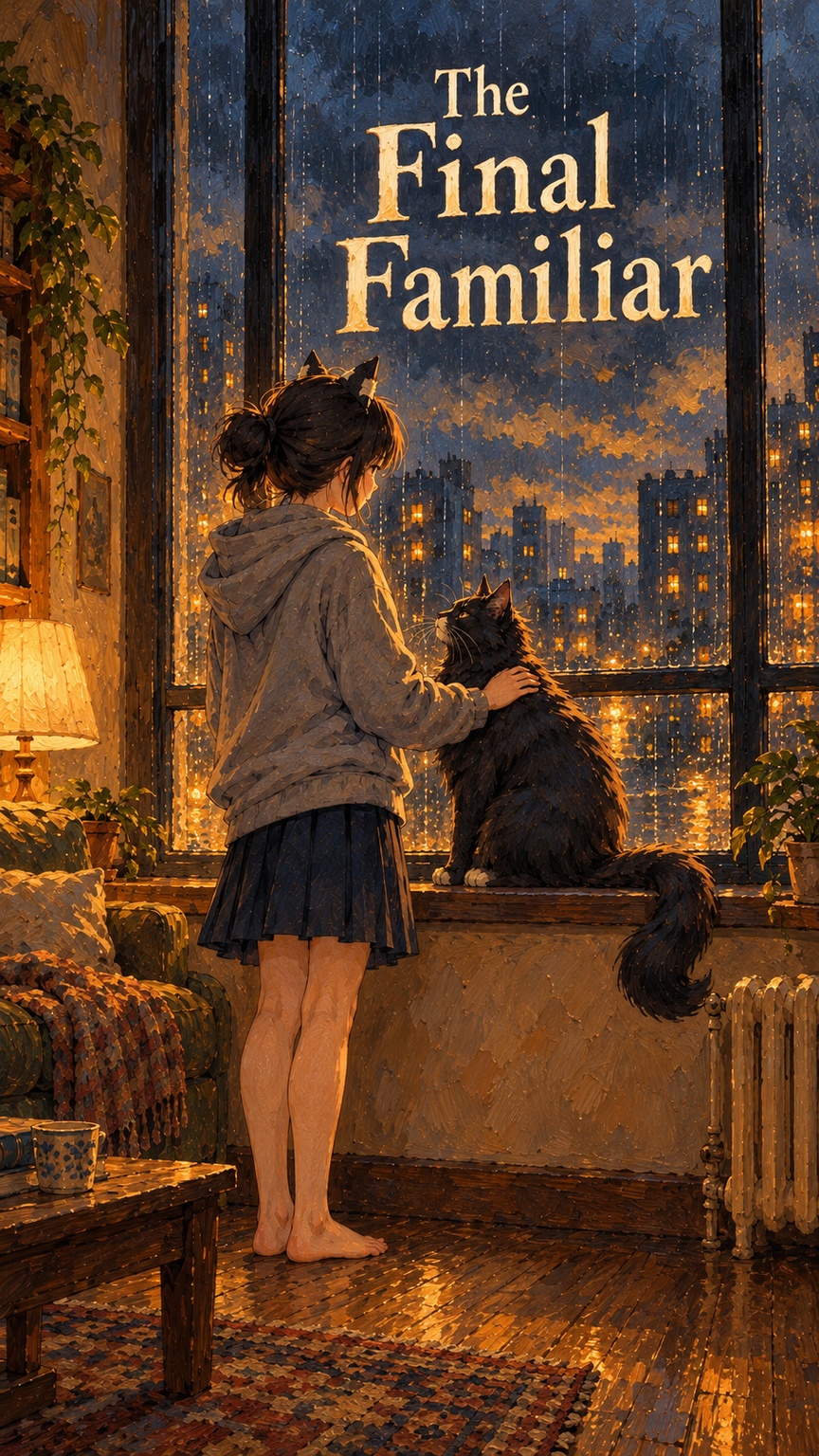
Miri found me under her building's front steps. She had dark hair twisted into a loose bun, a grey hoodie over her uniform, and two black paper ears sticking out of her bag. One ear was crushed.
“Oh,” she said. “You're awful.”
I looked behind me. There was no other cat.
She crouched and held out two fingers. I permitted an inspection. She had a small scar on her thumb and smelled of poster paint, apples, and somebody else's dog.
“Have you got anyone?”
I had had eight.
Before I could answer, she took off her hoodie, wrapped it around me, and carried me upstairs.
Her flat was on the fourth floor. The sitting room had a tall window, a small sofa, and a radiator with one hot end and one cold end. Miri tested them with her hand, laid a towel beside the hot end, and unwrapped me.
“Stay there. I'm asking Mum.”
She fetched her phone. There was a brief exchange about fleas, followed by a longer exchange about whose job it would be to buy food.
“Until we find out where he's from,” she said at last. “Yes. I know.”
She put the phone down.
“Temporary. Don't get ideas.”
On the towel, without being asked, she had folded one corner into a pillow.
I sat beside it. A sensible familiar does not become attached before establishing the terms of an assignment.
“I am here,” I told her, “to keep you happy.”
Miri stared. Then she looked at the television, which was off, and out through the sitting-room door.
“Dulcie?”
“No.”
She got down on her knees and examined the radiator.
“Where's the speaker?”
“Inside the cat.”
She checked beneath the sofa.
It was not an auspicious beginning.
The following morning I brought her sunshine.
It was precise sunshine, a circle three paces across, centred on Miri as she walked to school. Rain fell all around it. Her shoes remained dry. For four hundred yards I considered myself successful.
Then a boy across the road pointed. Miri shut her umbrella, opened it again, and stopped beneath a shop awning until I withdrew the circle.
“It's a gap in the clouds,” she said.
“A particularly attentive gap.”
“Don't do that at school.”
Sunshine was only the first of my provisions.
I had noticed her unhappiness over a page of arithmetic the previous evening. After she went to bed, I moved the ink into its proper arrangements. At lunchtime she returned to the flat carrying a sheet marked twenty out of twenty.
“You changed my homework.”
She was not smiling.
“The calculations were incorrect.”
“Yes. They're supposed to be my wrong answers.”
This seemed an unusual educational policy, but I was willing to learn.
“Mr Senn asked me to do the last one on the board. Because apparently I'd found a really interesting way.” She dropped the sheet in front of me. “I couldn't even read it.”
The interesting way had been devised by a woman who counted enemy soldiers from the intervals between their footsteps. I had perhaps been ambitious.
“Were you punished?”
“He thought somebody had done it for me.”
I examined the paper. There was room beneath the score for a correction.
“I can explain.”
“To my teacher? A cat?”
“My previous witches found me persuasive.”
“Your previous witches.” Miri rubbed both hands over her face. “Right. We're doing this properly.”
She took her last two biscuits out of a tin and put them on the table. I made my way towards them.
“No. On the towel.”
“You are offering an unclear incentive.”
She set a clear glass bowl over one biscuit, put her phone on a shelf, and asked me to move the biscuit without touching anything. I lifted it through the unbroken glass, brought it down, and lifted it again. She checked the glass, the table, the biscuit, and my paws.
“Again.”
I obliged.
“Now the other one.”
I obliged. Both biscuits revolved above the bowl. It was a tedious little orbit, but she watched it for some time.
“So,” she said.
I waited.
“Magic.”
“Yes.”
She sat down. A bus went by outside. The biscuits continued on their stately course.
“Does that mean I'm supposed to be able to do it?”
“Not unless you have omitted something from your description of yourself.”
She tried making one finger look commanding. Nothing happened.
“Good,” she said. “I've got enough homework.”
She made me put her arithmetic back as it had been. Then she ate one biscuit and gave me the other.
“You help when I ask. All right? No doing things to my stuff. Or to people.”
I agreed. Negotiating terms was familiar ground.
“And you're not a wizard called something ridiculous, are you?”
I considered telling her three of my titles.
“Bramble will do,” she said. “You've still got a bit in your tail.”
Dulcie arrived after school with a small keyboard and a bag of costume fur. She had two tight plaits, broad hands, and a laugh that began with a snort she tried to conceal by coughing.
“Mum says there isn't room for this in the car,” she said, setting down the keyboard. “So I'm leaving it with you.”
Miri plugged it in without answering.
They were performing at the school fête the next evening. They had performed the same song for three years, although Dulcie said it was now embarrassing and Miri said that was the point. I gathered the song concerned two cats who stole increasingly improbable objects.
“We ate the moon,” they sang.
“We ate the mayor.”
“We ate his most expensive chair.”
An indictment of municipal greed. I approved.
Dulcie played the wrong chord and they laughed so hard that Miri had to sit on the floor. I watched from the window. Her happiness, when it appeared, was easy to recognise. Getting it to appear was the difficulty.
“Last verse,” Dulcie said.
Miri picked up an ear. “This needs more tape.”
“We can do it without the ears.”
“It keeps falling over.”
They did the second verse again. Then Dulcie looked at her phone and began winding the cable around the keyboard.
“We haven't finished,” Miri said.
“I've still got to pack my bedroom.”
“You've been packing for weeks.”
“Yes, and somehow my bedroom's still in it.”
Miri put another piece of tape on the ear.
When the door had closed, she remained on the floor with the tape stuck to one finger.
“Where is she being sent?” I asked.
“Moving. She isn't being sent anywhere.”
“Ah.”
“Her mum got a different job. It's a good job.” She peeled the tape away. “Everyone keeps telling me that.”
“How far?”
“Four hours on the train.”
I had once crossed a winter kingdom in twenty-three minutes. I knew a way through distance, several ways around it, and a way to fold it which had unfortunately left my fourth witch's kitchen facing the wrong mountain.
“I could bring her back.”
“She's not a library book, Bramble.”
“I was contemplating a visit.”
“Then she'll go again.”
She began collecting the little pieces of tape. I went to the window, where the dying light lay warm on the sill. In my second life a witch had worn yellow shoes so I could pick her out among the wounded. I could still remember them standing side by side beneath her empty bed.
Miri stopped beside me and rubbed the place behind my ear where the bramble had caught.
“At least you don't have to move away,” she said.
I did not tell her about the orchard.
The fête was held in the school hall. There were stalls along the walls, a stage at one end, and high windows looking towards the city. Children ran between the chairs with prizes that appeared to consist chiefly of smaller objects inside larger objects. Someone had made a cake in the shape of a dragon and then cut off its head.
Miri brought me in a basket. Since I had agreed to help only when asked, I refrained from correcting the sign that said NO ANIMALS EXCEPT ASSISTANCE ANIMALS.
“You are assisting,” she whispered.
That was satisfactory.
There was already a spare costume ear in the basket. I sat on it.
Dulcie's mother had arranged a hired car to collect her from the school at five to eight. Her mother and their two large suitcases would be waiting in it. The train left at sixteen minutes past eight. These details were written on a scrap of paper tucked into Dulcie's keyboard case, as if writing them made them less likely to happen.
At half past seven, the girls put on their ears and drew whiskers on one another with a soft black pencil. Miri had changed out of her uniform blouse, but kept her skirt and the grey hoodie. Dulcie wore a red cardigan with one sleeve stretched over her palm.
“Do we want to run the ending?” Dulcie asked.
“We know it.”
“We haven't done it once.”
“We know it, Duls.”
Dulcie shut the keyboard case. For a moment her face was unlike the face she used with Miri. Then she looked down and tugged her sleeve straight.
Beyond the windows, the rain was thinning. Orange light lay between the towers across the city, catching the wet roofs. Miri stood beside my basket and watched it.
“Can you do big things?” she asked.
“Yes.”
“How big?”
“This building would present no particular difficulty.”
She glanced at me, trying to see whether I was joking.
“Could you make tonight not end?”
There were several things I ought to have asked her then. She was thirteen, wearing paper ears, with a piece of tape caught in her hair. I had led witches into rooms from which I knew they would never return. Surely I could give this one an evening.
“I have held places through worse than a sunset,” I said.
Her hand rested on the edge of the basket. She gave a little laugh.
“That would be something.”
At five to eight, their names were finally called. Dulcie glanced at her phone, then picked up the keyboard.
I stepped out of the basket, set my paws squarely on the floor, and opened my shadow.
It travelled beneath the chairs. It climbed the walls, slipping between stone and plaster, and reached out around the school. The working was old and strong. I had held a city inside it while my sixth witch broke the army at its gates. Nothing had entered. Nothing had been taken from us until I let the walls fall.
The hall warmed. The last orange light spread across the windows, and the ceiling shone as though the sun were just above it. Outside, raindrops brightened and hung. They did not stop falling; I kept lifting them as they reached the school, a shining curtain raised again and again. I could feel each of them through the tips of my whiskers.
Onstage, Miri looked towards me. Her eyes were enormous. Then she grinned.
The first verse went badly. Dulcie came in too early; Miri came in too late; they arrived at the mayor's expensive chair together, and the hall laughed. By the second verse they had recovered. Dulcie's fingers bounced on the keys. Miri forgot to be careful with her voice.
I watched her and held the light.
At eight o'clock a man carrying three jars of marmalade walked out of the hall and came back in through the same doorway.
He stopped. Looked behind him. Tried again.
The school clock ticked. Beyond my walls, the city was going dark.
Dulcie's phone, propped beside the keyboard, lit up. She glanced down and missed a note.
“Mum's outside,” she whispered.
“One more verse,” Miri whispered back.
At the rear of the hall a teacher was trying the other door. Each time she crossed the threshold she stepped back into the room. A few children laughed. Then the teacher called for quiet, and they stopped.
Dulcie took her hands off the keys.
“What is it?” Miri said.
The teacher stood at the door with one hand flat against the frame. Through the high window above her, a great black ear rose against the orange light. The shadow of my head sheltered the roof; my tail lay around the far wall.
“Oh,” Miri said.
I went to the stage. Dulcie was looking from the windows to the doors.
“It's all right,” I said. “Nothing can get in.”
Miri crouched in front of me.
“Can we get out?”
The question had never sounded like that during a siege.
There had been a witch, my fifth, who asked me to leave a door open. She was going out to speak to an enemy. I had obeyed, and she had come home. Another had asked the same thing, and hadn't. For a long time I had found it easier to remember the second.
My claws gripped the boards.
“I am holding the school.”
Dulcie had come to the edge of the stage. “Is that your cat?”
“Yes.”
“Is he talking?”
“Yes.”
“Has he shut us in?”
Miri's eyes flicked from the clock to the song sheet. There was time for the last verse now. There was time for an encore. Dulcie's mother could wait outside, and for a little while longer nothing would have to be packed away.
She stood up.
“We can finish it,” she said, very quietly.
Dulcie stared at her.
“I've got to go.”
“I know.”
“Now, Miri.”
“You don't have to sound so pleased.”
Dulcie's face changed. She caught the end of her sleeve, twisted it, and let go.
“I'm not pleased about this.” She pointed at the doors. “I'm scared.”
Miri glanced at me. I had not thought to look at Dulcie's hands. They were shaking.
“You sounded pleased before. You keep checking the time.”
“Because I don't want to miss the train.”
“You can't wait to go.”
“What am I meant to do? Not go? Have Mum give back her job?”
“I didn't say that.”
“You don't say anything. You just go all funny if I talk about it.”
The teacher was asking who had a key. A woman in the front row pulled her small son onto her lap.
Miri looked down at the song sheet. It had a drawing of the two cats in one corner, done when the girls were ten. They had signed their names across the top so their teacher would know it was their own work.
“You're going to have all new friends,” she said.
Dulcie rubbed her nose with the stretched sleeve.
“I hope so.”
Miri held the paper very still.
“I don't know anyone there,” Dulcie said. “I'm allowed to want friends.”
Miri looked towards the microphone. Dulcie had gone back to the keyboard and was lifting her fingers to the keys.
Miri put the song sheet face down.
“Don't play it,” she said.
Dulcie took her hands away.
Miri went to the microphone. It was too high, and she pulled it down with a small, horrible squeal.
“Sorry,” she said. She tried to swallow. “We aren't doing the last bit. Dulcie has to go.”
The hall was quiet now, although a child near the back was crying.
“And this is our last one,” Miri added. Her mouth trembled. “So thank you.”
She did not bow. She folded the song sheet into her pocket, then began pulling the keyboard cable out of its socket. Dulcie knelt beside her, and together they wound it up.
I had meant to hold an evening in which Miri was happy. Instead I had held Dulcie's frightened hands, a mother waiting in a car, a little boy pressed against his mother's coat. And Miri, who could have had her final verse, was giving it up.
My paws had begun to ache. It would have been easier to keep holding. I knew every part of the working. I knew how to make the walls thicker.
“The doors,” I said, in the voice I had used to cross battlefields. Everyone looked at me. “That is my doing. I'm opening them.”
I drew my shadow back through the stone.
The immense head lifted from the roof. The tail uncurled. Light ran down the windows like spilled paint, and the ordinary night came in behind it. Hundreds of raindrops struck the glass at once.
The man with the marmalade tried the door. This time he stayed on the other side. He leaned back into the hall.
“It's open.”
Miri did not look at me. She took the keyboard case from Dulcie and led the way out.
I followed with my tail low.
Dulcie's mother was standing beside the hired car. She grabbed Dulcie so hard that the paper ears fell off.
“I could see you through the glass. I couldn't get in. What happened?”
“It was the cat,” Dulcie said into her coat.
The driver looked at me.
“I held the school closed,” I said. “I shouldn't have.”
He got back into the car.
Dulcie's mother loosened her grip enough to look at her watch.
“We can't make it now. We can't.”
It was nine minutes past eight. The station lay beyond a tangle of wet streets, two rows of traffic lights, and the railway's long goods yard. The next train would not leave until morning.
Miri stood with the keyboard case bumping her shin.
“Bramble.”
I looked up. She was still not offering me her hand.
“Could you take us?”
“Yes.”
“All of us. And the cases.” She looked at Dulcie. “If you want.”
Dulcie's mother looked from her watch to the black shape of my shadow, which was already lengthening across the pavement.
“Wait,” she said.
I drew it back under me. She watched until the shadow lay small and still beneath my paws. Her hand remained closed around Dulcie's wrist.
“Can you do that safely?”
“Yes.”
“And if I tell you to put us down?”
“At once.”
She looked along the line of red brake lights in the road, then checked her watch again.
“Dulcie?”
Dulcie reached for Miri's free hand.
“Yes.”
Her mother paid the driver and helped him lift the cases from the boot. I let my body grow to meet my shadow. My back rose higher than the car; rain pattered on the broad bridge of my nose. The driver stood quite still, holding the receipt.
“How do we get on?” Dulcie's mother asked.
I lay down.
She climbed up first, hauling the cases into the hollow between my shoulders. The girls clambered after her. When they were settled, I rose.
“Please keep your claws to yourself,” I said, and leapt.
We crossed the school roof in one bound. For the next, there was only air, so I made it sufficient.
The city dropped beneath us. Rain streaked past my face. Behind my ears, Dulcie made a breathless noise that turned into a shout; Miri answered her, and their hands tightened in my coat. We passed a tower full of lit windows, close enough to see a man stop with a spoon halfway to his mouth.
“That's our bus stop!” Dulcie shouted.
“That's the shop where you dropped all the eggs!”
“You dropped them!”
“You were holding the bag!”
I gave them the length of that street, then turned towards the station. They called places to one another until the platforms came into view. Dulcie's mother, with her arms around both suitcases, was laughing and saying, “Oh, goodness. Oh, goodness,” as if she had misplaced the rest of her vocabulary.
I came down beside the station entrance with three minutes to spare.
There was a brief difficulty over the luggage. I wanted to carry it inside. Dulcie's mother said that she could manage it and that I would not fit through the door. It was a kind lie, and I accepted it.
Miri set down the keyboard case, and Dulcie hugged her. Miri put her face against the red cardigan and held on.
“I'm still cross with you,” Dulcie said.
“I know.”
“Not about the cat. Well. Also about the cat.”
“I'm sorry.”
“I know.”
A departure announcement sounded inside. Dulcie's mother touched her shoulder.
The girls pulled apart. Miri handed over the little paper ears she had picked up outside the school.
“You forgot these.”
“I'll send you a picture of my room.”
“Before you unpack it. So I can see it once.”
Dulcie snorted. Then they were laughing with their faces wet, and then her mother said they really did have to run.
Miri stood beside me until the doors of the station had closed behind them.
“Do you want to see the train leave?” I asked.
She shook her head. After a moment she sat down on the wet step.
I made myself small and sat beside her.
We walked home. She had asked to walk.
For much of the way she cried. I could have made the streets warmer, the distance shorter. I kept pace with her ordinary shoes.
At the flat she phoned her mother, who had heard a version of events from the school and required another. It was a long conversation. Miri did not conceal my part in it. Afterwards she sat on the floor and took off her wet socks.
“She says she's talking to you when she gets in.”
“Very well.”
“She sounds worse when she's being polite.”
“I have encountered that.”
The keyboard case stood by the sofa. Miri opened it and put the song sheet inside, with its last verse unsung.
“I liked the bit over the roofs,” she said.
“So did I.”
“You can't shut people in places, Bramble.”
“I know.”
“Even if you think it's good.”
“Yes.”
She closed the case.
“Can you go?” she asked.
I had prepared myself for this on the walk. I had several suitable phrases. The order had not always placed me with gracious people, and a familiar ought to know how to leave.
“Yes.”
“When you're finished with me. Where do you go?”
I told her about the orchard. It had a real location; I had visited it twice, and a gardener there knew exactly where to scratch a cat's chin.
“Is that what you want?”
I looked at the keyboard case. She would outgrow the grey hoodie. There would be other cases, other departures. One day I might be the one watching her hurry through a station door.
“I thought so.”
Miri pulled her knees up beneath her chin.
“I was horrible to Dulcie. She was scared and I still wanted her to finish the song.”
“You let her go.”
“After I was horrible.”
I had no useful correction to offer. We sat without one.
Then Miri said, “If keeping me happy is your job, you can stop. I don't want to be a job.”
There it was. The end of nine lifetimes of service, spoken by a girl with pencil whiskers smudged across her cheek.
“I understand.”
“But you could stay here. As a cat. If Mum says.”
She looked at me properly then. It was an invitation, and she was waiting for an answer.
“I would like that,” I said.
Her phone buzzed. The picture showed Dulcie and her mother in two train seats, their hair blown in every direction. Dulcie had put the paper ears back on. Behind them, the station lights made long bright lines in the window.
Miri made a small, uneven noise. She typed for a while, erased something, and typed again.
Then she got up and went to our tall window. The rain had softened. Lights shone in the flats across the street, and the low clouds caught an amber glow from the city. She stood with her hands in the pockets of her hoodie.
I jumped onto the sill beside her.
“Bramble?”
“Yes?”
“Next time we fly, can we go a bit slower?”
“That will depend on the train.”
She laughed, and put one hand on my back.
I settled my tail over the cold end of the sill. For the rest of that evening we watched the windows come on.