
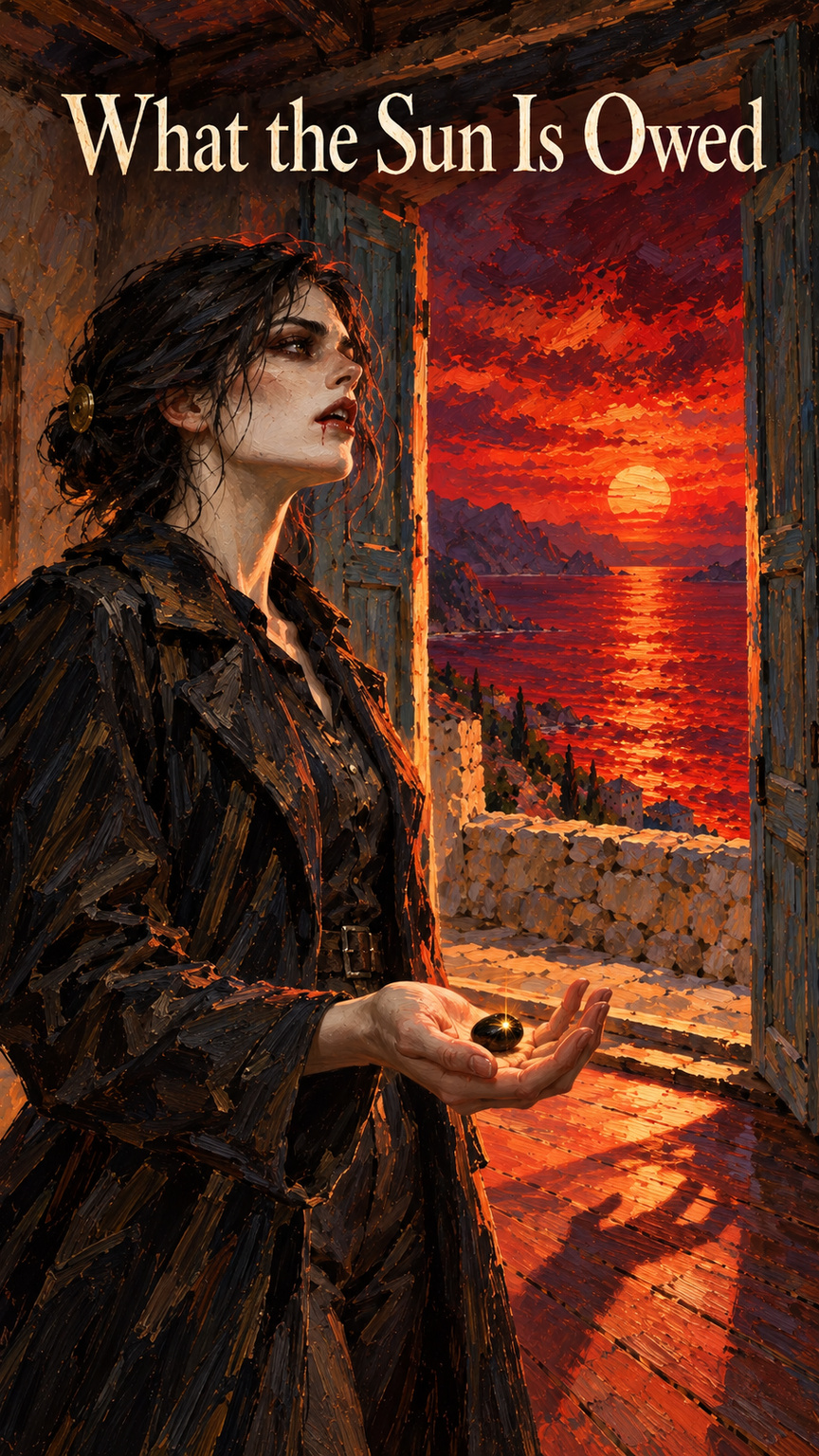
Ordan fastened the clasp in Neris's hair while she drank.
The blood was still warm. Neris held the white cup in both hands and felt its warmth pass through the walls of her stomach, into her wrists, along the roots of her teeth. The ache beneath her canines eased. A little blood remained on her lower lip. She caught it with her tongue.
“Keep still,” he said.
“You caught a hair.”
“I am attempting to release it.”
He had given her the brass clasp two hundred years ago, when she cut her black hair with a ship's knife and complained for a month about the pieces falling in her eyes. Now he held a caught strand between finger and thumb, working it free with a care she could feel all the way down her back.
He had been her father for two hundred and eighty-seven years. Before that he had been a stranger on a beach, kneeling beside the woman of twenty-four the sea had almost finished with. She remembered his mouth beside her ear, asking whether she wanted to live. She had managed to answer him.
The clasp clicked shut.
“There, daughter. You may shake your head at me again.”
She did. He smiled and went to inspect the shutters.
Beyond them the sailmakers' square was beginning its last hour of darkness. Someone was harnessing a horse below. Through the soles of her feet Neris felt the familiar shudder of the first cart taking the cobbles. She had rented these rooms because the square woke early. For a little while she could listen to a whole town beginning a day she would have to sleep through.
“It said my name again,” she told him.
Ordan's hand stopped on the shutter bar.
She had heard it at six dawns. At first she thought someone had come looking for her. The voice was quiet and close, although she could never place it beneath the window or outside her door. Yesterday she had heard it through the warm stone behind her bed.
“You know what to do.”
“I know what you told me.”
“That is a useful beginning.” He tried the bar a second time. “It calls to our kind. You close your mouth and let it pass.”
“Why?”
He turned toward her. Age had left him at the broad-shouldered, silver-templed man he had been when he took his first blood. Beside him, even after nearly three centuries, she was young.
“Because answering is how it kills you.”
“You always said the light did that.”
“Must I distinguish the teeth from the mouth?”
She set the cup down. He came back and put his palm against her cheek. It was warm; he had eaten before coming. She knew the small rough place beside his thumbnail, the weight of his hand, the ordinary pleasure of being touched by someone who expected her to be here tomorrow.
“We have a good life,” he said.
They had crossed seas and watched cities change their names. Sovel was planning a voyage with her beneath a comet that would return in a hundred and thirteen years. Last week Neris had heard a boy singing a song she had taught his great-grandmother. She loved being alive with an appetite still large enough for another century.
She wanted the other half of the world as well.
Ordan kissed her forehead and left for his cliff house by the covered walk. She heard his steps diminish beneath the cart wheels. When the square's lamps went out, she took the cup to the window.
“Neris.”
The voice was on the other side of the shutters.
She put her fingers on the bar. The wood had begun to warm.
“Neris.”
She had opened shutters thousands of times at dusk. She knew the weight of this one, the place where its hinge scraped, the splinter beside the handle. Her hand performed the familiar movements before she had finished imagining how much they might hurt.
The first blade of light lay across her pale wrist.
Nothing happened to her skin.
She pushed the shutter wide. Above the roofs the sun had risen clear of the eastern ridge. It was the pale, intolerable brightness she had spent her long life turning away from. Tears filled her eyes. She stood with her fangs pressing into her lower lip and waited for the pain.
“Neris.”
“Yes,” she said. “I hear you.”
The daylight turned crimson.
The colour passed over the square in a single movement. The white horse below became red, the cart wheels black. A woman cried out at the bread stall. Far beyond the roofs the sea darkened until it looked like a field of iron under the red sky.
Neris's cup fell from her hand.
Her shadow, cast long across the floor, turned its head to watch it roll.
She did not turn hers. She stood rigid while the dark outline stretched an arm across the boards. Its fingers hooked the cup's handle and pulled. The cup struck a table leg and broke. Blood spread between the white pieces.
The shadow kept reaching toward the window.
Outside, the shadow of the bread stall climbed the house behind it. The horse's shadow flowed under the cart while the horse remained where it was, trembling in its harness. Every dark shape in the square had begun moving against the things that made it.
Neris backed away. Her shadow did not come with her at once. Its hands spread on the floorboards as if it had found something to hold.
“I recognize you,” said the voice.
It came from the black shape at her feet. There was no volume to it, nothing she could have covered her ears against.
“You said my name.”
“I have said it at every sunrise since you took my fire into your mouth.”
She looked at the broken cup. Without thinking she crouched to retrieve the largest piece. Its edge cut her palm.
“Ordan said you would kill me.”
“I do not burn away what I am trying to recover.”
The blood in her hand shone. For a moment she could see a point of white inside each drop.
“Long ago, the first of you stole a star before it was born. He has it under his tongue. He drank of it and made others drink of him. I recognize what it has become.”
She had seen the dark thing beneath Ordan's tongue and thought it a broken tooth.
Her shadow reached for the blood in her palm. She lifted her hand. Its fingers slid up the table leg and stopped at the tabletop; they could not lift themselves from the wood.
“Bring it back before I leave this sky.”
“What happens if I do?”
“My fire leaves you. All of you.”
She thought of Ordan's hand against her face.
“We've been alive too long. There would be nothing left.”
“Your bodies are as they are. What has healed will stay healed. But nothing more will be renewed. You will live until your bodies end.”
“And if I don't bring it?”
“You will become the next star in the sky.”
Neris looked up. Beyond the red glare, somewhere she could no longer see, were the small lights she had used to find her way across dark seas.
“Will I be dead?”
“You will be alive without these hands. You will burn with what you have borrowed. The original theft will remain below.”
She closed her bleeding fingers.
The sun waited while the people in the square ran from their shadows.
At the bottom of the stairs Neris stopped beneath the unlit arch of the sailmakers' shop. No red beam reached the floor. Her shadow disappeared.
Under her ribs, something turned over in its sleep.
She pressed her fist against it. Her blood was warming without food.
“You are not hiding from something outside you,” the sun said.
She went on.
The square had emptied. Its abandoned stalls cast shadows that wandered along the walls without moving so much as a loose apple. Only hers had weight. When she crossed a thin strip of light between two awnings, a dark hand caught the hem of her black coat and pulled it toward the sun.
She stepped backward into the shade. The hand lost its grasp at the beam's edge. She put one boot into the light again; the fingers appeared on the cobbles beside it, reaching. She moved her foot an inch. The fingers moved an inch. They could choose what they did within her shadow, but they could not go farther than the light cast them.
“You gave me weight when you answered,” said the sun.
She tucked her coat clear and ran.
Sovel called from a doorway beside the navigation hall.
Her short grey hair was flattened on one side, as though she had risen too quickly from bed. She was wearing the green seacoat Neris had first seen on her eighty years ago. Her shadow had climbed the lintel and was examining the empty street.
“Get under here,” Sovel said.
Neris held out her bare hand in the light.
Sovel stared. “How long?”
“Since sunrise.”
“Does it hurt?”
“The light doesn't.”
Very slowly Sovel put one hand out of the doorway. Crimson brightened the old seams of her knuckles. She turned it over, then let a little of the light fall on her face.
She laughed once. The sound broke in the middle.
“All that time,” she said.
Neris had no answer. Sovel was looking down the bright street with a hunger Neris understood better than the one beneath her teeth.
“I brought the chart,” she said after a moment. “I thought I'd leave it with the night porter. Before all this.”
She had it rolled inside her coat. She unrolled it on the navigation hall's doorstep and knelt to hold down one corner. A comet's path had been added in blue ink above the coastlines. Neris recognized the small crosses they had made together, arguing over where the thing would look largest and which coast would give them the longest night.
“The new tables agree with the old ones,” Sovel said. Her voice was settling into familiar work. “A hundred and thirteen years. We can see it rise from here, make the southern crossing, and see it again from the islands. Unless you'd rather spend the whole voyage telling me I'm holding the chart upside down.”
Neris knelt beside her. The cut in her palm had begun to close. She put her uninjured hand flat on the paper and felt a century of future spread beneath it.
“Sovel. I answered it.”
Her friend stopped smiling.
Neris told her what the sun had said. While she spoke, Sovel's shadow came down from the lintel and lay across the blue comet. Sovel tried to push it away. Her hand passed through it and struck the paper.
When Neris had finished, Sovel folded the far edge of the chart over the blue line.
“And you've come to ask me.”
“I don't know.”
“Ask.”
“Would you give it up?”
“No.”
It was spoken at once, without anger. Neris found that worse.
“For me?” she asked, and hated herself while she was saying it.
Sovel took her hand off the chart.
“Don't.”
Down the street a man emerged to retrieve the white horse. Its shadow ran along the wall beside him. Neris watched him take hold of the bridle as carefully as if he were approaching a strange animal.
“I'm not asking you to go up there,” Sovel said. “I couldn't. But I want my life. The rest of it. Don't tell yourself I wanted this.”
Neris looked at the century they had folded away.
“I won't.”
The sun slipped over the navigation hall's roof. Light fell across Sovel's face. Neris lifted her hand between it and her friend's eyes before remembering there was nothing to protect her from.
“Why are you still covering her?” the sun asked.
Sovel could not hear it. She looked at Neris's raised hand.
“Habit,” Neris said.
“You could watch her for a thousand years. You would never do that again.”
She lowered her hand. Her fingers were shaking.
“Give me time,” she said to the red light. “There are people I have to ask.”
“You have had two hundred and eighty-seven years.”
“They haven't had today.”
The shadow beside her turned toward the cliff.
“The stolen star has had no days at all.”
Sovel rolled the chart, slowly, matching one edge to the other.
“I'll walk with you,” she said.
They went up the cliff road together. It wound away from the town and returned above it, climbing through the long morning until the roofs lay small beneath them. On the other side the red sea moved under a wind they could not feel from the road. Sovel kept the chart inside her coat, held against her ribs.
At Ordan's gate she stopped.
“I can't help you take it.”
Neris nodded.
“I'll be here,” Sovel said. She sat on the low wall where, for centuries, Ordan's visitors had waited for sunset.
Neris went into his house.
His shadow came down the stairs to meet her.
Ordan remained at the top. A narrow window behind him admitted a line of red light. His shadow stretched along the treads, touching each with its long hands. As she closed the front door, hers reached up the wall toward his.
“You came through the square,” he said.
“Yes.”
“In the light.”
“Look at me.”
He did. She watched him take in her face, her bare hands, the blood dried at the edge of her mouth. His relief was so plain that she had to hold the banister to keep from going to him.
“Let me see under your tongue.”
His mouth closed.
“Neris.”
“I know what it is.”
He looked past her at the door, then up toward the roof. Every part of this house could be closed against daylight. He had taught her how to check a room: door, window, chimney, the seam around a loose tile. She had learned the order before she learned to feed herself without shaking.
She climbed the stairs.
The high room opened onto a narrow roof terrace through a tall shuttered window. They had sat out there on summer nights with their feet against the parapet, listening to the sea beneath the cliff. Now the shutters were barred and a strip of cloth had been stuffed beneath the sill. Her shadow's fingers came over the top stair and stopped at the edge of the light from the stairwell window.
Ordan saw her injured hand.
“Let me have that.”
She held it behind her.
“Show me.”
He stood silent for a moment. Then he opened his mouth and lifted his tongue.
The supposed tooth was smooth and black, no larger than a plum stone. A tiny brightness moved far inside it. Looking at it made her remember the sea over her face: the weight, the depth, the smallness of the air she had once been able to hold.
He took it between finger and thumb.
“Give me your hand, daughter.”
She obeyed before she could stop herself.
He placed the seed against her cut.
Warmth ran up her arm. Her skin closed, leaving a clean line in the dried blood. The fire reached her mouth and she tasted the rich, sharp pleasure of being made whole. For a moment her fear receded beneath it. Her fingers wanted to close around the thing and keep it.
Ordan watched her.
“You remember.”
On the beach she had said yes to living. After the first swallow of his blood she had tried to take his wrist and drink again. He had let her. She remembered that too.
“Does it know?” she asked. “What you've done with it?”
“It has never woken.”
“It has waited,” said the sun.
Neris looked down. Her shadow had found the thin line beneath the terrace shutters. One black fingertip lay against the floor there, rubbing the wood.
Ordan followed her gaze.
“What did it say?”
“That it's waited.”
He took the seed off her palm and held it tightly.
“It has no use for the years as we do.”
“You don't know that.”
“No.” He put his closed hand against his chest. “I know I was afraid. I know I wanted another morning. That was all I wanted at first.”
“And then?”
He looked at her.
She sat down on the edge of the old cedar chest. There was still a notch in its lid where she had dropped a knife, learning to hold one with her new strength. Ordan had turned the chest around so she would not have to look at the damage. A hundred years later she had turned it back.
“Why didn't you tell me what the light was?”
“Would you have kept the shutters closed if I had told you it could speak?”
“I might have.”
“You opened them this morning.”
Her palm was whole. He had healed it as easily as he had once lifted her out of a dying body. She rubbed away the dried blood with her thumb.
“There are things outside the shutters,” she said.
“Yes. There is one outside them now.”
He went to the window and pressed the cloth more firmly beneath the sill. The fingertip disappeared. Somewhere below, a shutter banged although the wind had not changed.
“It wants you to think everything we have belongs to it,” he said. “When you see Sovel, will you tell her those were borrowed years? That the seas she crossed were someone else's?”
“I've seen her.”
“Then you know.”
Neris looked at her restored palm. “It says we stay as we are. We grow old from here.”
“How long do you think I have?”
“I don't know.”
“Neither do I. I had stopped counting.”
His voice had changed. She knew the tone he used when he wanted to make a hard thing gentle enough for her to accept. This was smaller and less certain.
He sat beside her, leaving room between them.
“I made you because I could not bear to let you die. It wasn't the only time. I've been selfish. I've been afraid. But you were alive, Neris. Every one of you has been alive. What does it think it can take back?”
She remembered Sovel turning her hand over in the light. The laugh that had almost become weeping.
“My fire,” said the sun.
The words came through the boards beneath the cloth. Ordan could not hear them. He sat waiting for her answer as though there were only two people in the room.
She asked where the others were. He gave her a winter port six weeks away, an island neither had visited in a century. She made him try to remember someone she could reach before dark. The afternoon light travelled along the floor while his answers took her farther from anyone she could ask. At last he told her of a woman who had stayed in this room after the sun called her name. Years earlier, when he made her a vampire, she had asked him to wait until her children were asleep.
Neris stood.
“I want to know what happens to a star.”
“You know what happens. Something calls your name, you answer, and there is no one left to bury.”
“Did you look for her?”
His fingers tightened around the seed.
“I searched this room. There was light where she had been standing.”
“And the stars that weren't there before?”
“Light is all that's left. Don't let it tell you that makes a person.”
She went to the terrace window. Ordan rose with her.
“Leave that closed.”
“I can't choose it without knowing.”
“You can choose to stay here.”
“Until sunset.”
He put his free hand over hers on the bar. She could have let it remain there. The room was familiar, the chest beneath the window, his warm hand over hers. Beyond the walls the world was red and strange, and she had been offered no way back to the morning before it.
She pulled her hand free and lifted the bar.
He caught the left shutter. She pushed the right one open.
Red light flooded the room. Their shadows sprang across the floor. Hers reached up the wall toward the seed in his hand. His flowed down the stair, leaving his feet behind.
Ordan shielded his face.
Neris put herself in front of him.
She realized what she had done when the sun spoke.
“Again.”
She held her place.
“What would I be?” she asked.
“You have seen stars.”
“I've seen lights. Is someone still inside?”
The red sky hung beyond the window. The sun had passed the height of the roof and was beginning its long descent toward the sea.
“I won't help you bring it back until you show me.”
“Neris,” Ordan said behind her. “There are things you cannot ask to be shown.”
The living sun narrowed its light upon her. Her own shadow turned its face up the wall and opened its mouth.
“Then hear.”
The sky parted.
The red glare drew away along a black seam, exposing a depth of night that should have been invisible at that hour. Within it stood a single star. Neris had sailed by it thirty years before. It had first appeared when she was young enough to believe that anything new in the sky was an omen meant for her.
Its light entered the room.
Her hands lost all sensation.
She looked down. They were still her hands, fingers bent, a clean line across one palm. Ordan took her wrist. She saw the pressure of his thumb against her skin and felt nothing.
“You still close the shutters,” someone said.
The voice came through Neris's teeth.
Ordan went still.
The star moved within its own light. At its centre Neris saw a face too large to grasp at once, a mouth she could have mistaken for a bright fold until it spoke again. The features changed as the immense fire moved. They returned to themselves. Someone was making them return.
“I thought you might open them before long.”
Neris tried to move her wrist in Ordan's hand. It moved. She could see that it moved. She had no way of feeling whether he was still holding her.
“Can you hear me?” she asked.
“Yes.”
“Are you alone?”
The fire folded inward. Far behind the face, in the deep night that had opened around it, small dark bodies shifted in paths Neris could almost comprehend. The star brightened; they turned. She felt the weight of them pass through the numb places where her hands should have been. For one instant she understood holding something too large to have an edge.
“No,” the star said. Then, after a pause: “Sometimes.”
Ordan spoke a name Neris did not know.
The face turned toward him. A white line crossed its mouth. It was the brief, unmistakable shape of fangs.
“After I answered, you said it would stop calling if I shut myself in,” the star said. “I waited behind the shutters until sunset.”
“I thought—”
“I know.”
He let go of Neris's wrist. She knew because she saw his hand drop.
“Can you come down?” she asked.
The face held its shape. Around it the burning surface lifted into peaks taller than the world below them. The little dark bodies kept turning.
“Where would I put myself?”
Neris tried to touch the clasp at the back of her head. She saw her fingers find it. She could not feel its teeth or the caught strands beneath them.
“You would remember,” the sun said to her. “You would remember how that felt.”
“Stop.”
The sky closed.
Sensation returned to her hands in a rush so sharp that she pressed them against her ribs. The brass clasp tugged her scalp. The room smelled of cedar and sea wind and the blood she had spilled into her sleeve.
She turned toward Ordan. His hand was out as if he had forgotten what he had meant to do with it.
Below the window, out on the cliff road, people were speaking all at once. They had seen the sky open too. A child called to someone to look again.
Neris had forced the room open. The strip of cloth lay in the middle of the red floor. There would be no returning to an uncertainty she could bear by keeping still.
“You didn't know,” she said.
Ordan shook his head.
She believed him. He had been wrong about how to save that person. He had still tried.
“I can't live up there,” she said.
The shadow on the wall turned toward her.
“You can.”
She looked directly into the sun.
“I won't.”
For a while Ordan said nothing.
Neris heard Sovel's voice below the window, answering one of the people on the road. The words were indistinct. Her friend was alive beneath this light, carrying a chart for a century Neris meant to take from her.
“What do you intend?” Ordan asked.
Neris turned back to him.
“To give it back.”
“Sovel doesn't want you to.”
“I know.”
“She could have another thousand years.”
“I know.”
He made a small, impatient movement. “Then say something else.”
Neris's shadow had come down the wall. It was reaching across the floor toward his closed hand. She stepped in front of it and put her foot on its wrist. The dark fingers flattened against the boards. She could feel their pull through her boot.
“I want to keep my hands,” she said. “I want to go somewhere without lighting it. I want to be able to leave. I want you to touch me and have it be more than something I remember.”
“So you will take our lives instead.”
“You'd still be alive.”
“Do you hear yourself?”
She did. She heard the sun saying that their bodies were as they were, as if that settled what the people inside those bodies might want.
“You can all keep living if I go,” she said. “That's what I know. I could do that for you.”
He watched her.
“I won't.”
The word hung between them. Ordan looked down at the hand he had put over hers on the shutter bar.
Outside, the sun had dropped low enough to send a long red band across the floor, from the terrace window to the head of the stairs.
Ordan opened his fist.
The seed lay against his palm. Its small inner brightness had quickened. Neris saw how tightly he had been holding it: it had left a smooth oval in his skin.
“Hold it,” he said.
She did not move.
“Before you decide for us. Hold it once without being hurt.”
He held out his other hand to her. It was the gesture he had used on the beach, offering something to take when she could no longer feel the ground beneath her.
She took the seed.
Its warmth gathered in her palm. Her hunger stirred and opened. She wanted to drink blood and sail beyond the charts, learn a new language, come home to a hand on her cheek. She wanted Sovel's blue comet. She wanted this afternoon to have happened to somebody else.
“You can keep it,” Ordan said. “It needn't stay with me. You can be the one who carries it. I'll show you where we went before there were houses to close. We can still go.”
She looked past him at the top of the stairs. His shadow was there, lying halfway down, its fingers spread toward the little star in her palm.
“Neris.”
This time both voices said it.
She turned her open hand toward the window.
Ordan caught her wrist.
His other hand closed her fingers over the seed. He had the strength she had learned to trust when he lifted her from a deck or caught her after a foolish jump. She could not loosen a single finger.
“I am not letting you do this.”
She pulled away. He held her easily. With one boot on the top tread he leaned over her, pressing her closed fist down against her chest.
The seed burned warmly through her fingers. In the blood beneath it something answered, glad to be alive.
He was forcing her sideways out of the sunlight. Her shadow narrowed across the top tread; the fingers beside his boot began to vanish.
Neris planted her free hand against the side wall and twisted her shoulder back into the red band.
The shadow spread across the tread. Its fingers caught his heel.
It was no more than the pull that had broken her cup. His weight was already forward, his heel half off the tread. His foot slipped the width of a finger.
He caught himself on one knee.
For that instant his grip loosened.
Neris tore her hand free and opened it to the light.
“Here.”
The sun took its star.
There was no warmth in her palm afterward.
The seed rose past the window, making a black point against the red sky.
Ordan got to his feet. He reached for it with the empty hand that had held it for so long. Neris caught his wrist, then let it go. She had no way to help him that he had asked for.
Above the town the point opened.
Crimson lines sprang from Neris's fingers, her mouth, the healed place in her palm. She felt them draw through her without taking any part she could name. The fierce renewal in her blood uncoiled. The cold beneath it did not vanish. It entered the room with the evening wind.
Lines shone from Ordan too. One passed out through his open mouth. He shut it and tried to catch the light against his lips.
Below, on the cliff road, Sovel cried out.
Neris went to the window.
A thin red thread climbed from her friend's hands. Sovel had dropped the chart. She was standing very still with her fingers held apart, watching the light leave them.
Across the town there were more threads. They rose from shuttered attics and covered passages, from a cart at the edge of the square, from the dark beneath a boat's upturned hull. Farther off, beyond the land she could see, lines curved over the world toward the opening star. Each had come out of someone who had expected a different tomorrow.
The sun gathered them.
For a moment Neris could see the whole sweep of its claim: the cliff, the town, the unseen coasts, the distant people standing up in rooms where night had just begun. The light had found every one of them. She felt how far her opened hand had reached.
The seed broke into white fire.
The sky gave way around it. Something large was being born at a distance she could not measure. The new light flooded the sea, filling every moving wave with a brightness of its own. On the road Sovel put an arm across her eyes. Ordan stepped past Neris onto the terrace and looked up without covering his face.
The newborn star grew smaller. The depth behind it lengthened until it stood among the others. It was still visible through the daylight, a clear white point in the western sky.
Across the roofs the red began to fade. The chimneys' shadows returned to their feet. The moving darkness beneath the horse settled into its proper shape. Neris's own shadow lay along the boards, one hand lifted because her hand was lifted.
She lowered it. The dark hand lowered too.
Ordan stood at the parapet. The sea below had become blue again.
Neris stepped out beside him. His face was the same face. The silver at his temples had not spread. The cut on her palm had not opened, and when she touched a fang with her tongue it was still there. But her pulse was beating faster than she had ever felt it beat at rest. She could hear Ordan's heart as well, hurried and small beneath the waves.
“Does it hurt?” she asked.
“No.”
He looked down at his hands.
After a while she felt a cramp beneath her ribs. She braced herself for the old hunger, the cold search for blood. It did not come. Instead she remembered the bread stall in the square, the smell that had risen from it every morning while she lay listening behind the shutters.
She would have to eat. Tomorrow she would have to learn what else her body needed.
On the cliff road, Sovel picked up the chart. She stood looking at it. Then she rolled it and put it inside her coat.
Ordan watched the new star. Neris could not tell whether he was seeing what he had stolen or what he had lost.
Then he lifted his gaze to the place the other star had appeared and spoke that person's name again. Neris looked for the face. She could not find it through the daylight. Somewhere beyond it the little dark bodies were still turning.
She reached for his hand, the hand that had worked the caught hair loose from her clasp that morning.
He did not take hers.
She let it rest on the stone between them. There was warmth in the parapet, the last of a day's sunlight. Below it the sea moved against the cliff. Sovel remained by the gate.
“Neris,” said the sun.
Her name came through the cooling stone. Nothing followed it.
The sun went down.